Matthew 4:12-17. Jesus Alone can Restore Us
In 1998 William Hague, who was later to become leader of the Conservative Party said in the first television interview about his religious beliefs:
“I certainly regard myself as a Christian and my politics are founded on Christian ethics and beliefs.”
He highlighted the ethical underpinnings of Tory policy which he believes should be consistent with the Christian faith, especially the similarities with regard to support for families and belief in limited government. It was striking that he emphasised ethics but omitted to emphasise the centrality of Jesus.
In a local radio broadcast I was invited to sit on a panel with a Sikh, a Muslim, a Jew with myself as a Christian. It was noticeable that all groups emphasised the importance of family and moral values, but the great difference was how we selfish human beings can become right with God and empowered to live in a way that pleases God. The centrality of Jesus, his death for our sin and his resurrection so we could also experience new life were we were widely different.
There are many religions and political parties that admire the moral teaching of the Sermon on the Mount that Jesus gave. However they have seldom seen the context or how it ends. Matthew wrote his record of the gospel to put the focus on a unique Jesus, the only Son of God and our only Saviour. Jesus was not just a great moral teacher, to be put alongside others religious and ethical teachers to give us in the West a helpful steer to help us see our way through the moral maze of the 21st century.
The purpose of Matthew’s record is to show how different Jesus is from everybody else. His lineage showed he was a direct descendant of King David, His extraordinary birth to a virgin, his miracles, his fulfilling the 330 prophecies about the Messiah given in the Jewish Scriptures, culminating in his execution and resurrection, and the content of his teachings are all recorded so we can know that Jesus is God’s King, his Messiah, who came to put people right with God. What John the Baptist taught is the essence of what Jesus taught as was to become the message of his church.
Another prophecy fulfilled
When Jesus heard that John the Baptist had been imprisoned by Herod Antipas, the Tetrarch of of Galilee and Perea (land east of the river Jordan), Jesus deliberately returned to Galilee. Up till this time he had lived in the unpopular area of Nazareth but he moved to the more significant town of Capernaum and this became his centre of operations.
“Leaving Nazareth, he went and lived in Capernaum, which was by the lake in the area of Zebulun and Naphtali”. Matthew 4:13
Matthew stresses where Jesus moved to as this fulfilled another Old Testament prophecy about the Messiah.
“. . . to fulfil what was said through the prophet Isaiah: “Land of Zebulun and land of Naphtali, the Way of the Sea, beyond the Jordan, Galilee of the Gentiles - the people living in darkness have seen a great light; on those living in the land of the shadow of death a light has dawned.” Matthew 4:14-16
Isaiah based his vision on the devastation of the northern lands of Israel around 733 BC when Tiglath-Pileser king of Assyria first invaded and captured just the northern areas of the Kingdom of Pekah, king of Israel:
“In the time of Pekah, king of Israel, Tiglath-Pileser king of Assyria came and took Ijon, Abel Beth Maakah, Janoah, Kedesh and Hazor. He took Gilead and Galilee, including all the land of Naphtali, and deported the people to Assyria.” 2 Kings 15:29
These maps help explain the relationship between Naphtali and what came to be known as Galilee
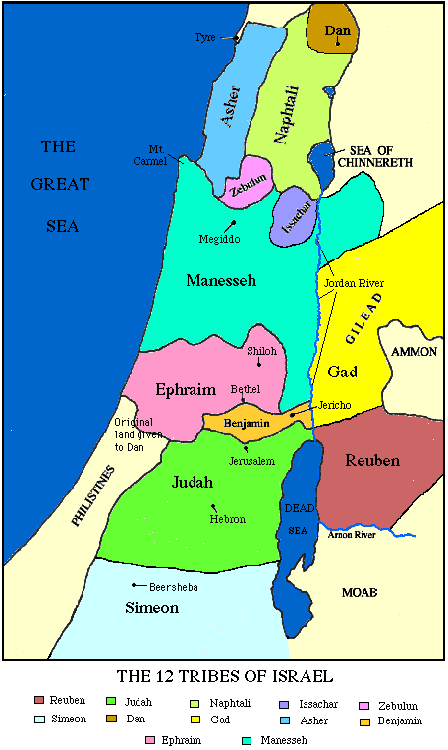
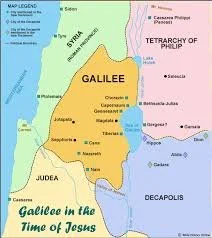
It had been precisely these same lands in the north of Israel that, 150 years earlier, Ben-Hadad, King of Syria, had captured from Basha, King of Israel:
“He conquered Ijon, Dan, Abel Beth Maakah and all Kinnereth in addition to Naphtali.” 1 Kings 15:20
No wonder it had always been a despised and rejected area of the Promised Land. In our world Donbas, Gaza and Southern Sudan are in the same situation as Gilead, Galilee and Naphtali were in Isaiah’s time. The people there were having a wretched time being a captive nation. Yet God promised through Isaiah:
“ . . . but in the future he will honour Galilee of the nations, by the Way of the Sea, beyond the Jordan. The people walking in darkness have seen a great light; on those living in the land of deep darkness a light has dawned. You have enlarged the nation and increased their joy; they rejoice before you as people rejoice at the harvest.” Isaiah 9:1-3
The ‘Way of the Sea’ was the major highway that went from Egypt to Damascus. It was along this route that most invaders from the East came.
Isaiah was looking forward to a time when these dispossessed people will see ‘a great light’. They were, metaphorically, in a dark place but a light will be coming. Notice that Isaiah used the past tense to emphasise that this promise was a good as done because it is the Word of God.
Matthew is making the point that this ancient prophecy was now fulfilled. Never before or since has that area known real peace but Matthew is saying that Jesus is the ‘light of the world’ and he came from precisely this area.
This prophecy is so relevant today for those who are going through dark times, there is a real light at the end of the tunnel, there is real hope because God himself has entered his world to save us and change us. Isaiah wrote:
“. . . on those living in the land of deep darkness a light has dawned.” Isaiah 9:2
Matthew follows the Septuagint version and says:
“. . . on those living in the the land of the shadow of death a light has dawned.” Matthew 4:16
Isaiah said:
“You have enlarged the nation and increased their joy.” Isaiah 9:3
This is not talking about a physical nation but about the Kingdom of God whose members will be filled with a deep joy that nothing can overcome.
So often when passages from the New Testament are quoted there is much to be gained from knowing the context. Many of the Jews would have understood this. Isaiah’s reference to Gilead, Galilee and Naphtali precedes the glorious prophecy that a child will be born who will be God himself and this child will become the Saviour of the world. He would become a blazing light, a ruler who will remove the darkness people were experiencing:
“For to us a child is born, to us a son is given, and the government will be on his shoulders. And he will be called Wonderful Counsellor, Mighty God, Everlasting Father, Prince of Peace.Of the greatness of his government and peace there will be no end. He will reign on David’s throne and over his kingdom, establishing and upholding it with justice and righteousness from that time on and forever. The zeal of the Lord Almighty will accomplish this.” Isaiah 9:6-7
This is extraordinary. This ruler is divine, he shares the nature of God. His kingdom will continue for ever. This can only be Jesus.
What is also extraordinary is the prophecy that just precedes the mention of Gilead, Galilee and Naphtali. It is must less well known but is staggering to those who study it. Isaiah is told that the Lord will not to follow popular thinking and share the fears of those around. People were terrified that Tiglath-Pileser would continue his invasion. Instead:
“The Lord Almighty is the one you are to regard as holy, he is the one you are to fear, he is the one you are to dread.” Isaiah 8:13
The Lord God was the rock on which they could stand securely and he will again be the sanctuary for all Jews, whether they lived in Israel or Judah or anywhere else:
“He will be a holy place; for both Israel and Judah he will be a stone that causes people to stumble and a rock that makes them fall.” Isaiah 8:14
This divine person will divide people, many stumbling when he comes:
“And for the people of Jerusalem he will be a trap and a snare.Many of them will stumble; they will fall and be broken, they will be snared and captured.” Isaiah 8:14-15
This is precisely what happened when Jesus appeared. People were divided over him, Satan snared them into rejecting their Messiah. However, this is the wrong way to react. God tells us all through Isaiah, not to focus and mull on our fears but trust in the living God who has revealed himself in his word:
“Bind up this testimony of warning and seal up God’s instruction among my disciples.” Isaiah 8:16
Isaiah then makes the decision that all people should make
“I will wait for the Lord, who is hiding his face from the descendants of Jacob. I will put my trust in him.” Isaiah 8:17
When people face problems, even today, such as when a loved one dies or guidance is needed, they may try to find comfort through spiritualists. This is nothing new. They did this in Isaiah’s time:
“When someone tells you to consult mediums and spiritists, who whisper and mutter, should not a people enquire of their God? Why consult the dead on behalf of the living?” Isaiah 8:19
The Lord is appalled at this reaction, why turn away from the living God who has revealed himself in his Word and turn to evil ways? Isaiah continues:
“Consult God’s instruction and the testimony of warning. If anyone does not speak according to this word, they have no light of dawn.” Isaiah 8:20
We are being clearly told that it is through the Bible that we can know both what God thinks and what he has done to save us. The promises of God are utterly reliable and that is a key message of the whole Bible.
Another preacher appears
Jesus’ emphasis was also the same as John the Baptist’s, God sees our hearts and our only hope is to completely change the direction in which we have been living and put him, God’s King on the throne of our lives. It is hardly surprising that the authorities were rattled.
“From that time on Jesus began to preach, ‘Repent, for the kingdom of heaven has come near.’” Matthew 4:17
This is the Kingdom that God is going to ensure is established.
If we combine the first words two spoken sentences of Jesus in Matthew’s gospel we read:
“Repent, for the kingdom of heaven has come near.”
“Come, follow me,” Jesus said, “and I will send you out to fish for people.” Matthew 4:19
Jesus is clearly announcing that this Kingdom of God where people can experience his peace is intimately related to himself, ‘Come follow me.’
Jesus is utterly different to all other religious leaders. He is so egocentric. Throughout the gospel this humble man unashamedly asks everyone to put him at the centre of their lives because he is none other than the Son of God. He defines Christianity in terms of himself, his rule and his Lordship. This is why ethical reconstructions that use the name Christian are totally inadequate.
Buddha taught the Four Truths and the Eight-fold path and emphasised reincarnation but he never pointed to himself. Muhammad possibly taught the Five Pillars of Islam but he would not point to himself. Hindu holy men may bid others to live pious lives but they would never say ‘in me’.
In the Sermon on the Mount this central theme is repeatedly made clear. Jewish teachers would interpret the Law but Jesus said:
“When Jesus had finished saying these things, the crowds were amazed at his teaching,because he taught as one who had authority, and not as their teachers of the law.” Matthew 7:28
Jesus unashamedly is claiming to be the ultimate authority:
“But I tell you that anyone who is angry with a brother or sister will be subject to judgment.” Matthew 5:21
“Blessed are you when people insult you, persecute you and falsely say all kinds of evil against you because of me.” Matthew 5:11
He even claims the right to decide who will enter heaven and who will not. At the judgment day he will say to some so-called Christian leaders:
“Not everyone who says to me, ‘Lord, Lord,’ will enter the kingdom of heaven, but only the one who does the will of my Father who is in heaven.” Matthew 7:21
Jesus is saying throughout the Sermon that it is our response to him that is the deciding factor on the day of judgment. Before he gave this sermon Jesus first insisted:
“Come, follow me,” Matthew 4:19
There are only two reasonable reactions to what Jesus was teaching. Either he is a wicked, deranged, egocentric maniac or they are the claims of God himself.The call of Jesus ‘Come follow me” has always been the message of the church. This is how the Bible ends:
“The Spirit and the bride say, ‘Come!’ And let the one who hears say, ‘Come!’ Let the one who is thirsty come; and let the one who wishes take the free gift of the water of life.” Revelation 22:17
Note that when people hear Jesus and come to him, their reaction will be to continue the work and say to others, ‘Come’.
BVP
Matthew 3:13-17 Who is Jesus?
The book of Matthew is all about answering this question, ‘Who is Jesus?’ Matthew records the baptism of Jesus to make the answer clear. He presents three sources of evidence:
1. John the Baptist
Jesus came down from Galilee as he wanted to be baptised by John the Baptist. For him baptism meant associating himself with the rest of humanity but more than that, his baptism was to mark his empowering by the Holy Spirit so he could embark on his public ministry. What a shame it is that too often today the association between the rite of baptism and receiving of God’s Spirit, so we can minister for Christ is overlooked. John was not a smooth talking diplomat but a clear thinking individual. He recognised that being religious is not the same as being godly, and said to the Sadducees and Pharisees:
“ You brood of vipers . . .” Matthew 3:7
Thousands of people from all over the region travelled for days to come and hear John. All sorts of people came, which is not surprising as there had been no prophet of God in Israel for 400 years.
He taught the people that they all need to repent because the arrival of God’s Messiah is imminent. He will empower his people with the Holy Spirit and with passion or fire but that he will also be our eternal judge:
“But after me comes one who is more powerful than I, whose sandals I am not worthy to carry. He will baptise you with the Holy Spirit and fire. His winnowing fork is in his hand, and he will clear his threshing floor, gathering his wheat into the barn and burning up the chaff with unquenchable fire.” Matthew 3:11-12
It was in this deserted place that John looked up and saw Jesus, who happened to be a cousin though they lived in different areas and travel in those days was not easy. He stops being the strong authoritative preacher who was rebuking the religious to being a humble man, full of awe and wonder. He saw Jesus approaching and recognised that Jesus did not need baptism for the forgiveness of his own sins:
“John tried to deter him, saying, “I need to be baptised by you, and do you come to me?” Matthew 3:16
John was identifying who Jesus is - the Messiah of God. In John’s record of the gospel we read about how John talked about Jesus
“. . . among you stands one you do not know. He is the one who comes after me, the straps of whose sandals I am not worthy to untie.” . . . John saw Jesus coming toward him and said, “Look, the Lamb of God, who takes away the sin of the world! This is the one I meant when I said, ‘A man who comes after me has surpassed me because he was before me.’ I myself did not know him, but the reason I came baptising with water was that he might be revealed to Israel.” John 1:26-31
Although John the Baptist was older than Jesus he recognised that he was ‘before him’ in that he was the Messiah God had promised. He also recognised that he would become the ultimate sacrifice for sin, he was the sacrificial Lamb of God.
Note that there is there is only one gospel, the news about Jesus the Christ who came to die for our sin and empower us to live for God, but we have four authors who wrote about this gospel.
2. Jesus
Jesus now enters centre stage and consequently John the Baptist drops out. John the Baptist described Jesus as the Son of God, saying:
“He must become greater; I must become less. The one who comes from above is above all; the one who is from the earth belongs to the earth, and speaks as one from the earth. The one who comes from heaven is above all. . . . For the one whom God has sent speaks the words of God, for God gives the Spirit without limit. The Father loves the Son and has placed everything in his hands.” John 3:30-35
In comparison to Jesus, no man is that important. Any power or authority anyone has, has been given by God.
The question now returns to who Jesus really is. The account of the baptism of Jesus and his subsequent temptation, when he was alone in the wilderness for 40 days, is sandwiched between the key lesson that God wants everyone to understand. John preached:
“Repent, for the kingdom of heaven has come near.” Matthew 3:2
After John the Baptist was arrested Jesus began his public ministry. He moved from Nazareth to the larger town of Capernaum:
“From that time on Jesus began to preach, “Repent, for the kingdom of heaven has come near.” Matthew 4:17
Both John and Jesus and his apostles had the same essential message, God’s Messiah has come to rule, so we must repent and live as members of his kingdom. Matthew wants us to grasp the necessity of repentance. This is not like a touch on the rudder of a yacht or a tweak to the compass bearing. It is far more than giving up chocolate for Lent, it is a radical change of direction to be the servant of the Lord Jesus for life.
The gospel message is that if we turn away from living for ourselves to living for him and his glory we have been given the right to be called children of God:
“Yet to all who did receive him, to those who believed in his name, he gave the right to become children of God” John 1:12
We must turn round because of who Jesus is. No-one should turn their back on their sovereign in this world, it is even worse to turn away from the Living God who entered this world out of love to serve us and save us by sacrificing himself.
3. God the Father
The word of God, spoken from heaven at Jesus’ baptism gives us God’s explanation:
“And a voice from heaven said, “This is my Son, whom I love; with him I am well pleased.” Matthew 3:17
This message is so reassuring. It is part of the evidence that turning to Christ is what God requires of us - God has said so.. We must turn to him because of who he is. God never asks anyone to do anything radical such as a complete reorientation of their life without giving a clear explanation.
The Bible teaches that God approaches our wills through our minds. Faith is always rational. That is the title of my website www.bvpalmer.com .
In this statement God gives us two clear reasons for following Jesus:
He really is God’s Son
He really is God’s Servant
Jesus really is God’s Son
Previously John the Baptist had been publicly proclaiming that he was God’s messenger announcing that God was going to visit his earth. Here God’s pronouncement gives us more information, it is essentially a repeat of Old Testament prophecies.
Isaiah 42
“Here is my servant, whom I uphold, my chosen one in whom I delight; I will put my Spirit on him. . .” Isaiah 42:1
At Jesus’ baptism this promise is repeated, except there is one significant change. Instead of saying, ‘This is my servant’, God says, ‘This is my Son.” Two Old Testament ideas are merged together, the Messiah is both God’s servant and his Son. God will put his powerful Spirit on him, and this is just what happened at Jesus baptism.
Psalm 2
This statement at Jesus’ baptism also encapsulates what God said in Psalm 2. This gives the clearest explanation that the Messiah will actually be God’s own Son. This remarkable psalm teaches both who the Messiah will be and what response is expected from all of us. It foresees that the nations will rebel against the rule of God and gives his reaction:
“The One enthroned in heaven laughs; the Lord scoffs at them. He rebukes them in his anger and terrifies them in his wrath, saying, “I have installed my king on Zion, my holy mountain.” Psalm 2:4-6
God then says to his Son,
“He said to me, “You are my son; today I have become your father. Ask me, and I will make the nations your inheritance, the ends of the earth your possession.” Psalm 2:7-8
This psalm then goes on to explain the reaction God expects from all people, people who naturally see themselves as kings of their own lives:
“Therefore, you kings, be wise; be warned, you rulers of the earth. Serve the Lord with fear and celebrate his rule with trembling. Kiss his son, or he will be angry and your way will lead to your destruction, for his wrath can flare up in a moment. Blessed are all who take refuge in him.” Psalm 2:10-12
To be wise, to serve the Lord, to kiss God’s Son and to take refuge in the Son is the response that God expects of all people.
Isaiah 11
This prophecy confirms that the Messiah will be a direct descendant of Jesse, the father of King David, and that he will be endowed with the Spirit of God:
“A shoot will come up from the stump of Jesse; from his roots a Branch will bear fruit. The Spirit of the Lord will rest on him - the Spirit of wisdom and of understanding, the Spirit of counsel and of might, the Spirit of the knowledge and fear of the Lord - and he will delight in the fear of the Lord.” Isaiah 11:1-3
The Holy Spirit of God will come upon God’s King, confirming that he is God’s eternal ruler.
The message of John the Baptist is that the Messiah has arrived in the person of Jesus Jesus then identifies himself and finally God confirms Jesus true identity. These are the three sources of evidence that Matthew presents. Note that Jesus never refuses to accept that he is God’s Messiah and later in his ministry he is open about this. This is what led to his crucifixion. He did extraordinary miracles that broke God’s laws of nature, The resurrection is the final proof that he is the son of God.
Notice how the devil understood the meaning of Jesus’ baptism and of God’s statement. When Jesus was tempted in the wilderness:
“ The tempter came to him and said, “If you are the Son of God, tell these stones to become bread.” Matthew 4:3
This was also the essence of the second temptation:
“If you are the Son of God,” he said, “throw yourself down.” Matthew 4:6
Jesus being the Son of God is the ultimate reason why we should turn to him and realign our lives into serving him. This is the only wise response. Not to do so is most foolish Yet how many today put themselves in to the category of being foolish:
“The fool says in his heart, ‘There is no God.’ They are corrupt, their deeds are vile; there is no one who does good.” Psalm 14:1
People may not reject God publicly, they may even go to church, but in their hearts they do not serve God or his Son. It is absurd to give all our energies, resources and time to our jobs or even to our families if God has revealed himself in his Son.
Nigel Lawson became Chancellor of the Exchequer in Margaret Thatcher’s government. He later agreed to be interviewed by the psychiatrist Dr Anthony Clare in his programme ‘In the Psychiatrist's Chair’ where he was asked:
“What do you think the point of life is?’
He replied,
“I don’t believe in anything beyond life. I just think it is our family that goes on for ever.”
Two sentences later he had to admit that he had sat at the bedside of his daughter as she died. If God has sent his Son, it would be absurd to go on living just for your family. God says, ‘This Jesus is my Son.’ Bring your family to him. Bring your whole life under his rule. It is absurd to put anything else above his rule.
What is it that stops people responding to the call of God that we must repent? When asked this question one man admitted:
“It is my pride. I will find it very hard to go back to tell my work mates and my family, ‘I have been going in the wrong direction.’
God gives us a clear explanation why we must change direction:
“And a voice from heaven said, ‘This is my Son, whom I love; with him I am well pleased.’” Matthew 3:17
Jesus really is God’s Servant
The Son of Almighty God has come to serve us, he came to die in our place. He really does love us. This is the second reason we are given as to why we must turn to him. Isaiah foretold:
“Here is my servant, whom I uphold, my chosen one in whom I delight;I will put my Spirit on him, and he will bring justice to the nations. He will not shout or cry out, or raise his voice in the streets. A bruised reed he will not break, and a smouldering wick he will not snuff out. In faithfulness he will bring forth justice; he will not falter or be discouraged till he establishes justice on earth. In his teaching the islands will put their hope.” Isaiah 42:1-4
Throughout the world people of all nations are crying out for leaders they can trust and whose decisions are all just and based on love. Jesus stands out, there never has been anyone like him. Isaiah, in his 4th song about God’s servant, God’s Messiah, wrote:
“Surely he took up our pain and bore our suffering, yet we considered him punished by God, stricken by him, and afflicted. But he was pierced for our transgressions, he was crushed for our iniquities; the punishment that brought us peace was on him, and by his wounds we are healed. We all, like sheep, have gone astray, each of us has turned to our own way; and the Lord has laid on him the iniquity of us all.” Isaiah 53:4-6
This passage then tells us that God’s servant will rise from death:
“Yet it was the Lord’s will to crush him and cause him to suffer, and though the Lord makes his life an offering for sin, he will see his offspring and prolong his days, and the will of the Lord will prosper in his hand. After he has suffered, he will see the light of life and be satisfied.” Isaiah 53:10-11
After his resurrection this same Jesus, whose love for us led to his death, will receive glory:
“Therefore I will give him a portion among the great, and he will divide the spoils with the strong, because he poured out his life unto death, and was numbered with the transgressors. For he bore the sin of many, and made intercession for the transgressors.” Isaiah 53:12
If this Servant of God was willing to die for me and was raised to sit in glory with his Father, who am I to refuse to bow humbly before him, with hearts full of gratefulness?
So when God introduces his Son, he uses the language of the suffering servant. It is he who is, as John the Baptist explained:
“Behold, the Lamb of God who takes away the sin of the world.” John 1:29
Jesus indeed became the ultimate sacrificial lamb.
One reason that some give for not accepting God’s call to follow his Son is that they don’t want to change the direction of their lives. I well remember one medical student who was interested in the Christian message. He recognised that the evidence for Jesus being God’s Son, who died for us and rose again, was very strong. However he declined the invitation to ask Jesus into his life and the reason he gave was ‘I like living as I am and don’t want to change’. He clearly hadn’t really understood who Jesus is and how much God loves him.
In contrast God’s focus is all on Jesus. He is not only God’s ruler but also his suffering servant. He embodies the love of God for each one of us. Jesus is calmly identified as such, the response God expects is clear and the reason why God expects this response is because he is both God’s King and his Suffering Servant. This is God’s message to each of us:
“And a voice from heaven said, ‘This is my Son, whom I love; with him I am well pleased.’” Matthew 3:17
John Williams was working for one of the large commodity firms in the City of London. He was not a Christian. He regularly received a copy of all the Penguin Books published in their classic series. He had just been sent Dr E.V Rieu’s translation of the four gospels. He had got as far as Luke’s gospel. Very late one evening he was travelling home by train from Victoria station. He settled into a corner seat and continued to read Luke’s gospel, having got as far as the trial of Jesus.
There were two other men in the compartment, one was an Englishman and the other an American. The Englishman suddenly had an epileptic fit and fell to the floor. The American leapt up to loosen his collar and put a handkerchief into his mouth to stop him biting his tongue. The American said to John Williams:
“I am awfully sorry but this happens several times each week. You see, we were in the Korean War together and I was wounded and left in no mans land, and this Englishman can and rescued me., carrying me to safety. Just as we were arriving at a safe position a shell landed beside us and the next thing that we knew was that we were in hospital. I was invalided out of the army, back to America. When I heard that the Englishman would never get better I left my job, broke off my engagement and came to England to look after him. You see, he did that for me. There is nothing I cannot do for him.”
By the time they arrived at the next station, the Englishman was improved and he and the American left the train. John Williams continued to read the story of the crucifixion of Jesus with that phrase still ringing in his ears:
“You see, he did that for me. There is nothing I cannot do for him.”
Suddenly he closed the book, knelt in the compartment of the train and gave his life to Christ. The significance of Jesus, the Son of God, coming as a Servant to die for him made sense. He realised he had to respond in the only way he could and become a follower of Jesus. The truth of what the apostle Peter said now made sense,
“Christ died to bring you to God.” 1 Peter 3:18
BVP.
Matthew 3:1-12 What Does Repentance Mean?
One important way that Biblical authors emphasise a key message is by the repetition of words. In this passage a repeated word is ‘Repent’, it comes three times. Matthew is stressing that the fact of God sending Jesus Christ as his chosen king or Messiah demands our response, we must repent.
The word ‘repent’ does not mean a sentimental feeling of remorse, it involves a change of direction. Literally the English word traces back to the Latin verb ‘pensare’ means ‘to weigh, think or consider’ so to ‘repent’ is to ‘reconsider’, ‘to change direction’. The Greek word for ‘repent’ is μετανοέω (metanoeō), which also means ‘to change one's mind’. It is a compound word, with ‘meta’ meaning ‘change’ and ‘noein’ referring to the mind, thought, or perception. So ‘repentance’ involves a fundamental shift in thinking and perspective, going beyond mere regret to a change of heart and intention. This in turn always leads to a change in behaviour. In the Bible repentance means to change direction so that Jesus takes the lead in our lives, it is a summons to return to God.
The Bible scholar, Don Carson, has said about ‘repentance’:
“What is meant is not merely an intellectual change of mind or mere grief. Still less doing penance but rather a radical transformation of the whole person. A fundamental turnaround involving mind and action. It includes overtones of grief, which results in fruit in keeping with repentance.”
Thus in this passage repentance led to action:
“Confessing their sins, they were baptised by him in the Jordan River.”
It is unfortunately all too easy for people to enjoy religious and even Christian activities and even to become religious leaders and not understand that the only way into eternal life is through the door of repentance. In verse 7 we read that many of the religious elite, the Sadducees and the Pharisees came out to hear John the Baptist. John realised what was in their minds and warned them:
“You brood of vipers! Who warned you to flee from the coming wrath? Produce fruit in keeping with repentance.” Matthew 3:7-8
Christian repentance is far more than a feeling, it results in a new direction in life. These religious people thought that because they believed orthodox doctrines and were part of the establishment, with a good pedigree that they must be in good standing before God. How wrong they were.
“And do not think you can say to yourselves, ‘We have Abraham as our father.’ I tell you that out of these stones God can raise up children for Abraham.” Matthew 3:9.
There is a very real judgment facing all of us and Jesus can see whether hypocrisy is in people’s hearts:
“The axe is already at the root of the trees, and every tree that does not produce good fruit will be cut down and thrown into the fire.” Matthew 3:10
Jesus gave a similar warning to some church leaders who had the outward appearance but whose hearts were not given to Jesus:
“Not everyone who says to me, ‘Lord, Lord,’ will enter the kingdom of heaven, but only the one who does the will of my Father who is in heaven. Many will say to me on that day, ‘Lord, Lord, did we not prophesy in your name and in your name drive out demons and in your name perform many miracles?’ Then I will tell them plainly, ‘I never knew you. Away from me, you evildoers!’ Matthew 7:21-23
This is why a reversal of direction a turning round is essential. The British Prime Minister, Margaret Thatcher. famously said,
“The lady is not for turning.”
However,, whether we will submit to the rule of Jesus or not is a vital decision It is very hard for many of us to admit that we have been going in the wrong direction.
A middle class successful Australian man started going to church. One day he summonsed his daughter and two younger sons and solemnly announced that he had an apology to make.
“I’ve been listening to what has been said in church, taken it all in, realised it is true and that I have been leading the family in the wrong direction for the last 18 years. I am deeply sorry but from now on we’re going a different way - Christ’s way”
That is an example of true repentance.
Matthew gives us here three convincing reasons why we should repent.
1. God’s Has Promised v. 3-6
This section begins with a quote from the prophet Isaiah. In this way Matthew is emphasising that all of Scripture is the Word of God and profitable for us.
“A voice of one calling: ‘In the wilderness prepare the way for the Lord; make straight in the desert a highway for our God.’” Matthew 3:3 and Isaiah 40:3
It is a strange coincidence that just as there are 39 books in the Old Testament, the first half of Isaiah consists of 39 chapters. Chapter 40 of Isaiah introduces the notion of a prophet preparing people for the coming of the Lord. Matthew is the 40th book in the bible, the first in the New Testament and this book also starts with a prophet, John the Baptist, preparing the way for the Lord.
This voice is calling on God’s people to prepare for the coming of the Messiah. He will come when they are ‘in the desert’. The message is urgent, the Messiah is coming, get ready. Just as when a President or Royalty are about to visit people tidy everything up, so we are told to do some hard work and make a straight highway for the Lord. Surely this is telling us to go straight! The response that people confessed their sins does suggest that this moral sense was well understood.
Isaiah’s message was that the Messiah, God’s chosen King is coming so get ready and make a fresh start, repent.
Why does Matthew talk about the clothes John the Baptist was wearing and the food he was eating?
“John’s clothes were made of camel’s hair, and he had a leather belt around his waist. His food was locusts and wild honey.” Matthew 3:4
There is a story in the Old Testament about King Ahaziah who had fallen from a height and was injured. He sent his servants to ask Elijah whether he would live. When they returned the king asked them:
“What kind of man was it who came to meet you and told you this?” They replied, “He had a garment of hair and had a leather belt around his waist.”The king said, “That was Elijah the Tishbite.”
Elijah was identified by his dress code. John the Baptist had emulated this dress as he wanted all to know that heals came with a warning that was from God. This is why the gospel writers are specific about his clothes - he was speaking on behalf of God.
The prophet Malachi had made a promise:
“See, I will send the prophet Elijah to you before that great and dreadful day of the Lord comes.” Malachi 4:5
The role of this forerunner to the Messiah was clear, it would be to call people to repent, to turn.
“He will turn the hearts of the parents to their children, and the hearts of the children to their parents; or else I will come and strike the land with total destruction.” Malachi 4:6
All God’s promises to us are fulfilled in Jesus, he promised he would come and now he has come. John’s message is timeless. It is relevant for both the first and second comings of Jesus. He is coming, so ‘Get ready’. It is only reasonable to remove all obstacles that are in the way of pleasing him.
During the Battle of Copenhagen in 1801, Admiral Horatio Nelson famously ignored a signal from his superior, Admiral Sir Hyde Parker, to retreat by holding a telescope to his blind eye. This story is the origin of the idiom to ‘turn a blind eye,’ meaning to deliberately ignore something. Nelson continued the battle, leading the British to a decisive victory.
Today there are many who treat God’s orders in a similar way and hope they will get away with this as Nelson did. God has only one word for such people, they are fools.
“For although they knew God, they neither glorified him as God nor gave thanks to him, but their thinking became futile and their foolish hearts were darkened. Although they claimed to be wise, they became fools.” Romans 1:21-22
Those who refuse to turn are refusing forgiveness, eternal life and the opportunity of being part of God’s family.
Shōichi Yokoi was a Japanese soldier found in Guam in January 1972. He had been hiding for nearly 28 years after World War II, refusing to surrender due to the shame of capture, even after the war ended in 1945. He lived in a handmade cave and survived on a diet of foraged food, eventually becoming a symbol of outdated pre-war Japanese values when he returned to Japan. There are many reasons people give for refusing to surrender to Christ but loss of face is a common reason. What would my family and work colleagues think? Such people forget to ask,
‘But what will God think and do if I refuse his offer of forgiveness?’
2. God’s view of us v. 7-10
God cannot be bluffed. Just as John the Baptist saw what the Sadducees and Pharisees were really like, so God can see what is in our hearts:
“You brood of vipers! Who warned you to flee from the coming wrath?”
Why were these senior religious people picked out for criticism? Their external veneer would have been impressive. If John had turned to prostitute,s thieves, paedophiles, rapists or murderers and warned them, everyone would agree with the criticism but why the morally correct, religious people. If they will be rejected by God what chance have ordinary people?
Why had the many Sadducees and Pharisees come? Was it possibly to add baptism to their religious Curriculum Vitae qualifications? Without repentance, baptism is a meaningless ritual. Perhaps they did not intend to be baptised but had come to find errors in John’s ministry. They did seem self satisfied:
“We have Abraham as our father.” Matthew 3:9
They possibly saw themselves above such popular enthusiasm. John the Baptist takes them head on.
“I tell you that out of these stones God can raise up children for Abraham.” Matthew 3:9
The Bible makes it clear that to be Children of Abraham, to be one of God’s Chosen People we each have to have the same personal walk with God that Abraham had. Having the right parents , being brought up in the right family and being subjected to the right religious ceremonies does not mean we are one of God’s people.
God said to Abraham,
“Behold, my covenant is with you, and you shall be the father of a multitude of nations.” Genesis 17:4
But Genesis makes plain that Abraham did not father a multitude of nations in a physical or political sense. Therefore, the meaning of God’s promise was probably that a multitude of nations would somehow enjoy the blessings of sonship even though physically unrelated to Abraham.
God said to Abraham:
“In you all the families of the earth will be blessed.” Genesis 12:3
God knew that Jesus would be Abraham’s offspring and that in him people of all nations could be blessed. God later said to Abraham:
“As for me, this is my covenant with you: You will be the father of many nations.” Genesis 17:4
Was this speaking about the Jews and possibly some Arab nations or did he mean that a multitude of nations would somehow enjoy the blessings of being God’s people without being physically related to Abraham.
Paul makes the meaning clear.
“ If you belong to Christ, then you are Abraham’s seed, and heirs according to the promise.” Galatians 3:29
To become a child of Abraham is to truly believe in the promises of God. Obeying the Lord Jesus is the proof that we belong to him. In a discussion on this subject with some Jews, Jesus distinguished being Abraham’s descendants and his children:
“I know that you are Abraham’s descendants. Yet you are looking for a way to kill me, because you have no room for my word. I am telling you what I have seen in the Father’s presence, and you are doing what you have heard from your father. “Abraham is our father,” they answered. “If you were Abraham’s children,” said Jesus, “then you would do what Abraham did.” John 8:37-39
Note that Jesus distinguishes being Abraham’s ‘descendants’ from being his ‘children’. Abraham was saved by God because he had a personal obedient faith in Him.
“And he received circumcision as a sign, a seal of the righteousness that he had by faith while he was still uncircumcised.” Romans 4:11
“Abraham in hope believed and so became the father of many nations, just as it had been said to him, “So shall your offspring be.” Romans 4:18
This is how Abraham has blessed the world and became the ‘father of many nations’.
These Sadducees and Pharisees thought they were ‘alright’. They didn’t realise how much they needed to be forgiven by God. Jesus told a telling parable about a Pharisee who went to the temple to pray:
“The Pharisee stood by himself and prayed: ‘God, I thank you that I am not like other people—robbers, evildoers, adulterers—or even like this tax collector. I fast twice a week and give a tenth of all I get.’” Luke 18:11-12
In contrast a tax collector prayed:
“God be merciful to me a sinner.” Luke 18:13
Jesus then explained that it was the tax-collector who ‘went home justified before God.’ Jesus had told this story to some:
“. . . who were confident of their own righteousness and looked down on everyone else.” Luke 18:7
This vital truth is something those of us who have some sort of faith must understand. Only Jesus can save and he only saves those who are utterly dependant on who he is and on his death as the substitute for our sin.
3. God forgives and changes us through Jesus. v. 11-14
Today there are many who hope they will be acceptable to God because of the religion or church they belong to. In his day there would have been many who said, ‘I am a follower of John the Baptist’. But John the Baptist is saying:
‘I do not have the power to offer forgiveness.’
No person, whether ordained or not, has this power to forgive sins and the tendency to sin. All we can do is follow the example of John and point others to Jesus. Ezekiel tells us that God has promised one day to send his Holy Spirit into all his people who will wash away our sin and wash our hearts. It is God himself who can cleanse us from our sin and bring forgiveness. There are some whose understanding of repentance is limited. They tell people:
‘Turn around and follow God, flee from the coming wrath.’
However if this message is one without the forgiveness that Jesus offers they will simply be turning to face the God of wrath.
Martin Luther
In his early days, Martin Luther feared and resented God, viewing Him as a wrathful judge rather than a gracious saviour. This intense fear stemmed from his understanding of God's ‘righteousness’ as God's holiness and therefore his active punishment of sinners, a concept he came to despise as he desperately tried to earn God's favour through his own works as a monk. His perspective shifted only after a theological breakthrough coming from his study of the Bible, leading him to realise that God's righteousness was a gift given through faith, not something earned. Luther initially saw God as a terrifying judge who demanded impossible perfection and then punished humans for their failures. He saw God's righteousness as a force that actively condemned him, not one that offered mercy. As a monk, Luther's efforts to appease this wrathful God were ceaseless. He engaged in severe penance, fasts, and vigils, believing that through his own works he could become righteous enough to earn God's favour. This was ultimately futile and left him feeling empty.
The change came when he re-examined the Bible, particularly the book of Romans. He had an epiphany where he understood that God's righteousness was not something to be earned, but was given as a gift through faith in Christ. He came to see that:
“For in the gospel the righteousness of God is revealed—a righteousness that is by faith from first to last, just as it is written: “The righteous will live by faith.” Romans 1:17
God’s gift is to share his righteousness with his people because we belong to his Him.
This understanding transformed his view of God from one of fear and anger to one of grace and love, a change he described as feeling like he had "gone through open doors into paradise".
It was a disaster that Church authorities had been mistranslating the word ‘repent’ as ‘do penance’ for nearly 1,000 years. Jerome’s Vulgate translation of the Bible had rendered ‘metanoia’ as “paenitentiam agite,” which means “do penance.” Penance was taught to be an act of punishment or atonement for sin, in spite of the fact that there is nothing we can do to atone for our sins. This turned repentance into something to be accomplished through confession to a priest or bought through indulgences. This error was exposed in Luther’s lifetime thanks to the publication of a new Latin translation of the New Testament Greek taken from ancient manuscripts by Desiderius Erasmus. The Greek word in question ‘metanoia’, is a common term in the New Testament, meaning, as we have seen, ‘a change of heart’ or ‘a change of mind.’
In the second thesis of the 95 Theses, Luther supported Erasmus’ understanding of ‘metanoia’ saying:
"This word cannot be understood as referring to the sacrament of penance, that is, confession and satisfaction, as administered by the clergy.”
Luther argued that this mistranslation had created an entire penitential system that undermined Christ’s atonement by adding man-made laws, which instilled unnecessary guilt and uncertainty in the hearts of Christians while consolidating power in the hands of the papacy.
It is God alone who can save us, our role is to introduce people to the Saviour. The condition God insists on if anyone is to be accepted into His kingdom is that we must repent and turn our lives over to following Jesus, God’s Son. It is his death that has won our salvation.
John’s emphasis was on the necessity of there being a change of heart. He said:
“I baptise you with water for repentance.” Matthew 3:11
The water used is not holy water, even the act of baptism of itself saves nobody. Baptism symbolises the washing of rebirth that God gives us when we truly repent. In the New Testament this is associated with the gift of the Spirit to empower us to live for Christ. If baptism does not result in a change to being more like Jesus, it is a meaningless activity as far as that individual is concerned.
John is telling his listeners, and us, that Jesus is not to be trifled with. So often we try and put Jesus in the dock and judge him when the reality is that it is he who will judge us.
“But after me comes one who is more powerful than I, whose sandals I am not worthy to carry. He will baptise you with the Holy Spirit and fire. His winnowing fork is in his hand, and he will clear his threshing floor, gathering his wheat into the barn and burning up the chaff with unquenchable fire.” Matthew 3:11-12
This loving Christ gives all of us who repent His Holy Spirit who will change us. The evidence of his presence in our lives is that we will increasingly:
Love Jesus
Love His Word
Love to rest in the assurance of his salvation
Love to obey him, live lives that please him
Love to pray
Love His people - fellow Christians
Love others still outside of Christ as they are also God’s creation
Love to share the gospel about Jesus with others
Look forwards to being with our Lord in heaven
Any who fail to repent and turn to Christ will eventually have to face him in judgment and the prospect of eternal rejection by him. Not to repent is sheer folly. It means rejecting the facts of history as well as the voice of conscience. We cannot go on hoping to bluff God, hoping that all will work out well in the ned. It won’t without Jesus Christ. Not to repent is to ignore God’s greatest gift to us, the forgiveness he offers us in his Son.
BVP

Matthew 7:13-14 The Broad and Narrow Ways

In this final section of the Sermon on the mount Jesus calls his hearers to make a decision about him. He is saying that we must all decide:
“Enter through the narrow gate. For wide is the gate and broad is the road that leads to destruction, and many enter through it. But small is the gate and narrow the road that leads to life, and only a few find it.” Matthew 7:13-14
This follows on from that epic statement that summarises the central section of his teaching:
“So in everything, do to others what you would have them do to you, for this sums up the Law and the Prophets.” Matthew 7:12
The ‘others’ here includes God as well as our neighbours. When Jesus was asked later what were the most important of the Lord’s commandments he summarised it in similar terms, by quoting from the book of Deuteronomy, part of the Torah:
“Jesus replied: ‘Love the Lord your God with all your heart and with all your soul and with all your mind.’ This is the first and greatest commandment. And the second is like it: ‘Love your neighbour as yourself.’ All the Law and the Prophets hang on these two commandments.” Matthew 22:37-40
Jesus now comes to his conclusion, he drives home his message and calls on all of us to make a response. He does this by contrasting the two possible roads that people take.
Two Gates
The first gate is very wide and is easy to get through. Indeed it is so broad that it is easy to pass through it without realising it is there.
The other gate is small and might even seem to be insignificant. It is certainly ignored by many. It is tight and not easy to get through. It reminds me of my visits to Spurs football ground. To get in to have to pass through a very narrow turnstiles - I could only squeeze through.
Jesus is talking about entering his Kingdom, starting out on the Christian life. At the beginning of the Sermon, Jesus taught the Beatitudes, where he describes the mindset of those who are to be blessed by God. To realise how spiritually poor we are, to be poor in spirit, to mourn over our sinfulness, to be meek (not weak) before God and others, to hunger and thirst for righteousness. He then acknowledges that such people will not have an easy life:
“Blessed are those who are persecuted because of righteousness, for theirs is the kingdom of heaven. ‘Blessed are you when people insult you, persecute you and falsely say all kinds of evil against you because of me. Rejoice and be glad, because great is your reward in heaven, for in the same way they persecuted the prophets who were before you.” Matthew 5:10-12
Jesus keeps repeating that our eyes should always be on the next life. To be blessed by God gives us an assured hope of life with him in eternity. It is a large claim. As in the rest of the sermon, those who are looking for an easy life will not notice the narrow gate or find it at all attractive. If we do, it is a sign that God is calling us to himself. Remember what Jesus said in the centre of the sermon:
“‘Do not store up for yourselves treasures on earth, where moths and vermin destroy, and where thieves break in and steal. But store up for yourselves treasures in heaven, where moths and vermin do not destroy, and where thieves do not break in and steal. For where your treasure is, there your heart will be also. . . ‘No one can serve two masters. Either you will hate the one and love the other, or you will be devoted to the one and despise the other. You cannot serve both God and Money.” Matthew 6:19-24
The Greek word for ‘money’ used is mamōnas or ‘mammon’. This is a transliteration of an Aramaic word meaning wealth, property, or money or any worldly values. Jesus is saying we cannot serve God and worldliness at the same time.
To pass through the narrow gate means that much that we value, that we would naturally want to hold tightly onto, has to be left behind if we are going to pass through the narrow gate. It could be called the ‘narrow gate of repentance’. We realise that all we have, has been given to us by God and now our lives and all we have are to be used for his glory. This is a repeated theme of Jesus. Later he reminded his disciples:
“Whoever wants to be my disciple must deny themselves and take up their cross and follow me.” Matthew 16:24
Jesus is saying that those who turn to him as a cheat ‘eternal life insurance policy’ have missed the point. He wants people who will serve him and live for God. He calls us to leave our self-interest behind.
Two Ways
The contrast between the two paths is clear:
“ . . . broad is the road”, is very different to “ . . . narrow is the road.”
The broad road is easy to rush along, there is plenty of room for everyone. You can live as you want, rest when you feel like it. You make the decisions as it is you who is in charge. A person like this could be described as
“A self-made man who worships his creator"
This witty remark - often attributed to John Bright regarding Benjamin Disraeli, implies that a person is arrogant, or proud of their own accomplishments that they effectively worship themselves.
The narrow road is very different. It is bumpy and hard going. Again this is a picture to remind people that members of God’s kingdom are not free to choose their own way, their decisions are now guided by the mind of God.
It is important to stress that those who decide to pass through the narrow gate and travel on the narrow way will never be alone. At first sight it seems to be a very tough decision. The writer to the Hebrews recognised this but he reminds his readers of one vital fact:
“Keep your lives free from the love of money and be content with what you have, because God has said,“Never will I leave you; never will I forsake you.” Hebrews 13:5
What a wonderful promise God gives to all who follow him. It keeps being repeated in Scripture. When Joshua was commissioned to lead the children of Israel into the Promised land and defeat the Canaanites he was told this path would not be easy, he was to live as God teaches in his Word, but again God gave him a promise:
“Keep this Book of the Law always on your lips; meditate on it day and night, so that you may be careful to do everything written in it. Then you will be prosperous and successful. Have I not commanded you? Be strong and courageous. Do not be afraid; do not be discouraged, for the Lord your God will be with you wherever you go.” Joshua 1:8-9
To those on the broad road, looking across at those on the narrow way they can only see the restrictions, they do not see the joy of walking in step with our creator. Earlier in this sermon Jesus is very clear that we still have to make this decision even though we are also concerned about all the normal worries of life. Can we trust God? Jesus says:
“ But seek first his kingdom and his righteousness, and all these things will be given to you as well.” Matthew 6:33
What is so attractive about Jesus is that he makes the costs and benefits absolutely clear. He is not like so many politicians who say what they think their voters want to hear. Jesus is straight. There are just two gates and two roads.
Two Groups
Those who enter through the wide gate and travel along the broad road are many. This is not surprising as the road is apparently easy to progress along. I remain at the centre so it naturally appeals. Being in a crowd is so reassuring. Surely we can’t all be wrong - can we? Could the minority be in the right?
The other group, on the narrow way are fewer in numbers, though still significant.
“. . . and only a few find it.” Matthew 7:14
Jesus used a significant verb. Those on this way have had to ‘find’ it, they were looking for salvation. Jesus had said a little earlier:
“‘Ask and it will be given to you; seek and you will find; knock and the door will be opened to you.” Matthew 7:7
There are people who say that they are interested but are waiting for God to do something to pull them over the line of commitment to him. There is a Chinese saying:
“Man stand long time, with mouth wide open, waiting for roast duck to fly in.”
Our consciences may be pricked and our desire for purpose clear but then it is up to us to determine who Jesus is and whether what he says, that does resonate with our consciences, is really true.
What is it then that draws people to go through the narrow gate and travel on this harder road? Jesus said later to his followers:
“‘Whoever wants to be my disciple must deny themselves and take up their cross and follow me.” Matthew 16:24
Jesus is not the smooth-talking salesman, he honestly longs that people with travel with him. That is the secret - the God of this universe has promised to accompany us through life and give us real joy and satisfaction in our service of him. The Lord himself promises to be always close to us.
Two destinations
This is fundamental. Just as students have to work hard if they are going to do well in the exams, or sportsman have to train hard if they are to succeed, so putting God first in life will lead to the ultimate reward. There are many satisfactions in this life that in themselves make following Christ worthwhile, but it is the destination that is crucial.
“For wide is the gate and broad is the road that leads to destruction, and many enter through it.” Mathew 7:13
For those who do not seek to satisfy God the ending could not be worse. They will end up outside God’s Kingdom, rejected by the God who entered this world to save us. The Jews expected that God would accept them simply because they were born as Jews. Jesus teaches that the chosen people, the descendants of Abraham, are those people who have a similar personal faith in the Lord as Abraham had. People of all nationalities will become followers of God’s Messiah and so will be saved. Jesus said later,
“I say to you that many will come from the east and the west, and will take their places at the feast with Abraham, Isaac and Jacob in the kingdom of heaven. But the subjects of the kingdom will be thrown outside, into the darkness, where there will be weeping and gnashing of teeth.” Matthew 8:11-12
At the final judgment there will be much unhappiness when, too late, people realise they have not sought out the salvation that Jesus alone can give us.
Jesus is encouraging us all, in that while the journey may be arduous, the destination will make all our dedicated hard work so worthwhile. All that makes life hard will pale into insignificance when we finally meet Jesus and be with him.
Two choices
Although there are two gates, two roads, and two groups Jesus wants everyone to understand these truths, not so that we are just better informed but so that we may act and make a wise decision. There are only two possible destinations:
“Whoever believes in the Son has eternal life, but whoever rejects the Son will not see life, for God’s wrath remains on them.” John 3:36
We all decide one way or the other. Yet there are people who do not want to make a decision. They want to wait until they understand more or are more convinced. In practice the vast majority of those who don’t want to make a decision do so because they do not want God to be their God. In practice they have already decided. To say, “I am not going to choose” is to say that I am not taking Jesus seriously. Not to decide to follow Christ is to say I want to stay as I am, on the easy path where I am in control.
By default we are all on the broad way and we have to make a positive decision to leave that road and pass though the narrow gate onto the narrow road. Jesus message keeps being repeated.
“Turn off the broad road, repent and come, follow me.”
A decision is made
Imagine the crowd travelling along the broad road. They have passed through the broad gate and taken no notice of the signpost their that says:
“To Destruction”
They are happily travelling along. Everyone has a rucksack on their back. Some rucksacks are large others smaller but everyone has one. They represent their sin, their innate rebellion against God’s rule and the actions that result from this.
Then one person, going with the crowd notices the small gate going off at the side. It has a signpost that says:
“To Life”
Something draws him to investigate. It all makes such sense. The person knows instinctively that he has not lived as God wants and when he hears that he can be forgiven and given a power to live a different, God-centred life he feels drawn to this. As a result he starts going in the opposite direction to the crowd.
“What’s up with you. Are you thinking of joining the God-squad?’
Those around mockingly ask suck questions. What better reply could be give than:
“I know I am a sinner before God and I want to end up in heaven and not hell. Doesn’t truth matter to you any more?”
When this person tries to pass through the narrow gate of repentance they find that the rucksack on their back is preventing them passing through. Sin is a major impediment. However at this point someone says:
“Can I take that burden of sin from you?”
It is Jesus, who then takes that burden and placers it at the foot of his cross. That person is then free to pass through the narrow gate and starts travelling along this new route. The difference is that there is someone else constantly travelling alongside. It is the Spirit of God himself. The problems and hurdles are real, but now there is real help at hand that enables us to overcome all difficulties. This road ends at eternal life.
To reject Jesus is to reject God. To reject ‘life’ will inevitably result in ‘destruction’.
If we believe Jesus is who he claimed to be, proved by fulfilling those 330 Old Testament prophecies about the Messiah, doing extraordinary miracles, rising from the dead after three days and teaching what surely resonates with our inner consciences, then the choice we have to make is straight forward. Jesus lays down stark realities and demands that each of us makes a response. He says:
“Follow me, accept my forgiveness and empowerment and receive life or reject me, go your own way and face the eternal awful consequences.”
To teach us about this choice is why Jesus came to his earth, he longs that we turn to him. He pleads with and commands us to repent, to rethink the direction of our lives.
About 1250 BC Joshua was coming to the end of his life. He had made this decision to follow the Lord but he realised that many of those who were formally God’s people had still not made a personal commitment to follow the Lord. He called all the people together and said to them:
“Now fear the Lord and serve him with all faithfulness. Throw away the gods your ancestors worshipped beyond the River Euphrates and in Egypt, and serve the Lord. But if serving the Lord seems undesirable to you, then choose for yourselves this day whom you will serve, whether the gods your ancestors served beyond the Euphrates, or the gods of the Amorites, in whose land you are living. But as for me and my household, we will serve the Lord.” Joshua 24:14-15
John’s gospel has the same message about the privilege of receiving Jesus as our Saviour and Lord:
“Yet to all who did receive him, to those who believed in his name, he gave the right to become children of God – children born not of natural descent, nor of human decision or a husband’s will, but born of God.” John 1:12-13
What a privilege.
BVP

Matthew 4:1-11 What Should I Believe In?

Everybody has something they believe in, something they live for. For some it is just their football club, others it is their career, popularity or family but we all believe in something. All people are people of faith, what differs is what we believe in.
Martin Luther King Jr. connected faith to action, courage, and perseverance, viewing it as a force to overcome uncertainty. He is quoted as saying,
“Faith is taking the first step even when you don't see the whole staircase”.
Our faith or beliefs shape the way we live. Some have faith in ‘scientific materialism’, thinking that what they can see is all that there is. Atheists believe that there is no creator and that when we die the chemicals that made my body return to the soil and the cycle of new life being formed is repeated. The difficulty they have is logically deriving values such as honesty, love and beauty and the need for integrity from such a faith, so usually other beliefs are co-opted in even though it is impossible to see where they come from logically
Some business men make their career their overriding faith. Success and money are their goal. “Money” was a track from English progressive rock band Pink Floyd in 1973 which epitomises this belief:
“Money, get away
A new car, caviar
Four star day-dream
Think I’ll buy a football team”
Many rise early in the morning, get home late, pursuing materialistic goals, thinking ‘I’ll get as much as I can whilst I can’. Unfortunately such goals are only seen to be empty when they die. What have they then?
Sir Richard Branson (born 1950) is an English business magnate who co-founded the Virgin Group in 1970, controls many companies and financially he is worth billions. In his biography he obviously values his family. He has immense energy and was given his knighthood for his contribution as an entrepreneur. He founded Virgin records, Virgin airways and Virgin railways. Yet he is an atheist,
“I would love to believe," he said. "It's very comforting to believe”.
Yet he clearly does believe in many things but has chosen not to accept the rule of God.
What people believe in shapes how they will shape our lives. There is no such thing as a non-believer. Most of us have a portfolio of beliefs that usually involve what we enjoy most.
Matthew has written this book to ask us if our belief system stands up under scrutiny.. In this passage we read that Jesus’ beliefs were tested to the limit and his responses confirm who he is. Matthew has one major aim in chapters 1-4, he wants everyone to understand who Jesus is and therefore to turn and trust completely in Jesus Christ. He is showing us that Jesus is God’s only Son, he is his Messiah, his King so, because of this, we should leave all other ideologies and trust and follow only him.
John the Baptist’s essential message was:
“Repent, for the kingdom of heaven has come near.” Matthew 3:2
Jesus’ essential message was the same:
“Repent, for the kingdom of heaven has come near.” Matthew 4:17
All people must turn round the direction of their lives because God’s Kingdom and God’s Son have entered his world.
That all people, religious or not must repent and turn to Jesus is the message of the whole Bible. As an example, look at the book of Ezekiel, written when God’s people had been sent as slaves to Babylon. God’s message to them was the same as it always is:
“Do I take any pleasure in the death of the wicked? declares the Sovereign Lord. Rather, am I not pleased when they turn from their ways and live?” Ezekiel 18:23
“Repent! Turn away from all your offences; then sin will not be your downfall. Ezekiel 18:30
“For I take no pleasure in the death of anyone, declares the Sovereign Lord. Repent and live!” Ezekiel 18:32
“Say to them, ‘As surely as I live, declares the Sovereign Lord, I take no pleasure in the death of the wicked, but rather that they turn from their ways and live. Turn! Turn from your evil ways! Why will you die, people of Israel?’ Ezekiel 33:11
“If a righteous person turns from their righteousness and does evil, they will die for it. And if a wicked person turns away from their wickedness and does what is just and right, they will live by doing so.” Ezekiel 33:18-19
Matthew is telling us all that we must turn and give our loyalty to Jesus. In this passage we are told that Jesus proved himself to be God’s son by the way he was tried and tested. Jesus stood up under fire as no other person and no other belief systems can do.
Some, when interpreting this passage focus on the temptations we will face and how to deal with them, but Matthew is saying much more than this. His focus is on who Jesus is, he is continuing to say that Jesus proved himself to be our Lord and Saviour by the manner he overcame the most severe temptations.
Revision
At Jesus’ baptism God identified his Son in no uncertain terms:
“This is my Son, whom I love; with him I am well pleased.” Matthew 3:17
God is picking up on the great prophecy of Isaiah, - here are two translations:
“Surely he took up our pain and bore our suffering,” (NIV)
“Surely he has borne our griefs and carried our sorrows;:” (ESV) Isaiah 53:4
Literally, the Hebrew of the Isaiah prophecies says ‘he lifted off’ our pain or griefs. It is as if you have a great pile of work on your desk that you cannot cope with and then someone else takes it off you out of the goodness of their heart - out of grace. The word translated ‘bore’ or ‘carried’ is literally ‘shouldered’. God will shoulder or take responsibility for all that troubles us. Isaiah is saying that God’s King, his suffering Servant, will lift off our burden and take responsibility for it. But what is this burden we carry? The next verse answers this:
“But he was pierced for our transgressions, he was crushed for our iniquities; the punishment that brought us peace was on him, and by his wounds we are healed.” Isaiah 53:5
Isaiah is saying that the Messiah, the Suffering Servant, would die as our substitute. He would take responsibility for our sin. Isaiah then explains how the Messiah would fulfil all that the Old Testament sacrifices modelled:
“We all, like sheep, have gone astray, each of us has turned to our own way; and the Lord has laid on him the iniquity of us all.” Isaiah 53:6
The question we all need to answer is whether Jesus really is this person that God has promised. Can he open the the gateway to heaven by fulfilling the ministry of the suffering Servant?
The Temptations of Jesus
Jesus substantiated his claim to be God’s Messiah by the way he overcame these three very real temptations. .
God still allows us all to face temptations and other pressures, he tests us to know what is in our heart. Jesus was also repeatedly tested but he passed each test, so proving that he is truly the Son of God.
“Then Jesus was led by the Spirit into the wilderness to be tempted by the devil. After fasting for forty days and forty nights, he was hungry.” Isaiah 4:1-2
This testing after 40 days mirrored the 40 years the Israelites were tested in the wilderness. ‘He was hungry’ was surely an understatement but this was also what the Israelites faced. The Israelites were hungry and feared starving in the wilderness, which is why God provided manna as a daily food source, teaching them to rely on God rather than their own resources.
First temptation v. 1-4
Satan came to Jesus when he was weakened by hunger and tempted him seek the supernatural help instead of trusting what God says
“The tempter came to him and said, ‘If you are the Son of God, tell these stones to become bread.’” Matthew 4:3
If Jesus had opted to use his divine power to serve his own needs and comfort it would have undermined his whole ministry. He had left heaven to become God’s Suffering Servant, to take on himself the suffering and separation from God that our sin deserves. If he failed in this test he would have failed to fulfil God’s will. If he failed here he would never be willing to go to the cross. If he failed here he was not the perfect suffering Servant who would die for us out of love. In the Garden of Gethsemane, instead of saying:
“Not my will, but yours be done.” Luke 22:42
He would have been meaning:
“Not your will but mine be done.”
If Jesus had given in to an earthly appetite he would be a sinner just as we are so he could not be the ‘lamb of God who takes away the sin of the world’ (John 1:29). What Peter said would be untrue:
“He committed no sin and no deceit was found in His mouth” 1 Peter 2:22
It is therefore significant that Jesus answered by reminding Satan what God’s word says in Deuteronomy 8:3:
‘It is written: “Man shall not live on bread alone, but on every word that comes from the mouth of God.” Matthew 4:4
The words Jesus quoted come immediately after the words of God in Deuteronomy explaining why people are tested.
“Remember how the Lord your God led you all the way in the wilderness these forty years, to humble and test you in order to know what was in your heart, whether or not you would keep his commands. He humbled you, causing you to hunger and then feeding you with manna, which neither you nor your ancestors had known, to teach you that man does not live on bread alone but on every word that comes from the mouth of the Lord.” Deuteronomy 8:2-3
Jesus is acknowledging that he is the Son of God and that God has spoken and all people must listen. Jesus passed this test. Isn’t this the issue that Matthew wants us all to grasp? Whatever problems we face, we must not immediately look to the supernatural but trust in what our heavenly Father has said.
When Jesus quoted from the Old Testament he affirms that the Jewish Scriptures are God’s authoritative word and that he himself is the LORD God.
“Jesus answered, It is written: ‘Man does not live on bread alone but on every word that comes from the mouth of God (Greek θεός).’” Matthew 4:4
This original quotation in our Bible reads:
“ . . . that man does not live on bread alone but on every word that comes from the mouth of the LORD.” Deuteronomy 8:3
Jehovah and God (theos) mean the same.
The lesson for us is clear. We must feed on the word of God if we are to be spiritually well-nourished. To fail to study the Bible as we approach all the temptations of life is worse than entering for an exam and not doing any preparation for it.
Second temptation v. 5-7
Jesus is next tested on whether he will trust what God has said about who he is or will he seek further supernatural confirmation:
“Then the devil took him to the holy city and set him on the highest point of the temple. ‘If you are the Son of God,’ he said, ‘throw yourself down. For it is written: “He will command his angels concerning you, and they will lift you up in their hands, so that you will not strike your foot against a stone.” Matthew 4:5-6
Jesus knew the 330 prophecies about himself in the Jewish Scriptures and he had just heard God say:
“This is my Son, whom I love; with him I am well pleased.” Matthew 3:17
Now Jesus was being tempted to doubt what his Father had said.
In the wilderness,God similarly promised his people that he would be with them through thick and thin but they repeatedly put God to the test and did not obey him. They did not trust his word. Sadly we all act similarly but Jesus alone is different, he has passed the test.
I once picked up a hitch-hiker who turned out to have been a soldier in the Falklands War. He and his company had been descending down Tumbledown hill to Port Stanley when they came under intense machine gun fire. He said that his friend next to him was hit in the head and died instantly. He then added,
‘We all dug in as best we could and we all prayed”.
I asked if even the atheists prayed:
“Oh yes, we all did.”
“Do you still pray?” I asked.
“Oh no, I don’t need to now!”
Unfortunately many treat God in such a way, only turning to him when there is a real problem and when the problem is over forgetting what was prayed. Too often God is treated as a commodity.
If Jesus had decided to opt for the spectacular, miraculous path that Satan had suggested, instead of trusting his Father to watch over him and care for him through all hardships, he would not have been able to face the real horror of the cross. Would he call on legions of his angels to deliver him? No, Jesus had given up all the privileges of being God when he came to earth as the Suffering Servant. Matthew wants us to see that Jesus knew that he was God’s Son because of what the Scriptures said, because of what His Father had said at his baptism, so he must act accordingly by faith. He refused to take a short cut. He could have descended from the cross but he again refused because he was not only the Son of God but also the Suffering Servant:
“Those who passed by hurled insults at him, shaking their headsand saying, “You who are going to destroy the temple and build it in three days, save yourself! Come down from the cross, if you are the Son of God!” Matthew 27:39-41
Thankfully Jesus replied to Satan:
“It is also written: “Do not put the Lord your God to the test.” Matthew 4:7
Here Jesus is again quoting from the time the Israelites were in the wilderness and were deviating away from the Lord:
“Do not follow other gods, the gods of the peoples around you;for the Lord your God, who is among you, is a jealous God and his anger will burn against you, and he will destroy you from the face of the land. Do not put the Lord your God to the test as you did at Massah.” Deuteronomy 6:14-16
There is only one God and Jesus is saying that he is that God.
This temptation to look for signs and miracles has always been a strong device of Satan. After the miraculous feeding of the 4,000:
“The Pharisees came and began to question Jesus. To test him, they asked him for a sign from heaven. He sighed deeply and said, “Why does this generation ask for a sign? Truly I tell you, no sign will be given to it.” Mark 8:11-12
Jesus strongly rebukes those who demand signs as a condition for belief, calling them a ‘wicked and adulterous generation’. This ‘adultery’ is spiritual, referring to a heart that is unfaithful to God and seeks external proof rather than trusting His character and his word.
“He answered, “A wicked and adulterous generation asks for a sign! But none will be given it except the sign of the prophet Jonah.” Matthew 12:39
They had already been given so much evidence for Jesus being God’s Messiah, they had heard what he taught and did not want to obey. The biblical standard for a relationship with God is to:
“. . . walk by faith, not by sight.” 2 Corinthians 5:7
Repeatedly looking for signs can reveal a lack of trust in God’s promises and a desire for control rather than surrender.The Lord is still looking for willing obedience to all that he says in his word.
Third Temptation v. 8-10
The devil took him to a very high mountain and showed him all the kingdoms of the world and their splendour.
“All this I will give you,” he said, “if you will bow down and worship me.” Matthew 4:9
This offer was absurd. Jesus had created the whole world but then deliberately had left the glory of heaven to come and suffer of that cross for each of us. Satan is offering him a shortcut to glory. No cross needed, you can keep your glory. What Satan omitted to mention was the rest of humanity who are separated from God by our sin. If Jesus did not take that path we could never be forgiven. Satan was appealing to the self-centred side all humans have yet Jesus alone always refused to give into this temptation. He had come for you and me. If he had given in to the temptation of worldly glory he couldn’t have completed his commission. He was offered ‘glory on earth’ at the expense of an ‘eternal glory in heaven’. Thankfully Jesus replied
“Away from me, Satan! For it is written: ‘Worship the Lord your God, and serve him only.’” Matthew 4:10
This verse was again taken from the time the Israelites were in the wilderness. It follows after the ‘Shema’ where the Jews were reminded what their chief responsibility is:
“Hear, O Israel: The Lord our God, the Lord is one. Love the Lord your God with all your heart and with all your soul and with all your strength.” Deuteronomy 6:4-5
Jesus is again applying this to himself,
“Worship the LORD your God, serve him only.” Deuteronomy 6:13
There can be no doubt what Jesus wants us all to understand by relaying this story to Matthew. He is the Lord God, he is the Messiah but he is also the Suffering Servant. We are called to follow him, whatever the cost.
Application
Although there are many lessons we can to learn from this passage about how we should face various temptations, the point that Matthew focuses on in these first four chapters is who Jesus is. Through overcoming these very real temptations we can see that he is truly God’s Son as well as God’s suffering Servant. The ‘Kingdom of heaven is near’ because the King has come.
Matthew sees the Messiah much as we would see a marathon runner entering the stadium at the end of a gruelling race. All the focus is rightly on him.
Back to where this article started. We all have something we believe in. We are all people of faith. Yet it is not uncommon to hear people say,
“I wish I had your faith.”
Such people have put their faith in something that is only temporary. Careers, scientific materialism, family, religion or hobbies or a mixture of these. Christians are convinced that God really did step into his world, he came as both God’s Messiah, the Son of God, and as God’s Suffering Servant. Our faith is based on strong historical evidence, on the fact that what Jesus taught resonates with what we instinctively know to be true. On top of this we have this evidence about how Jesus faced the temptations that we all face, and came through unscathed.
The question we are each being asked is:
‘Does my faith stand up to such an investigation?’
Is my god or are my gods selfless? Would my faith give itself for others eternal well being? Can it give a hope that lasts beyond the grave? Does my god claim to be King of Heaven and the Son of God? Is there really evidence that my gods live.
Christians have decided to obey God and have him as the priority of our lives, we listen to His Word and trust him even when life becomes difficult. We are committed to learning about what God has promised and how he wants us to live. We follow Jesus because he has entered the stadium of history and has lived a perfect life. Everything points to Him, he is tried and tested.
God says to each one of us:
“This is my Son, whom I love; with him I am well pleased.” Matthew 3:17
This is why we must ‘Listen to him’. The alternative is to face eternity without him.
There are other points we can learn from this account:
Satan is a real enemy who is out to seduce us just as he tried to undermine Jesus’ ministry.
All of us will be tempted in our service of the Lord, just as Jesus was at the beginning of his ministry
The central place the Bible has in a Christian’s life. Jesus had learned the Scriptures through committed hard work, so it is important for all his people to commit themselves to the same goal. ‘The Word of God is the sword of the Spirit’
Jesus can sympathise with us as we face difficult times and temptations. “Because he himself suffered when he was tempted, he is able to help those who are being tempted.” Hebrews 2:18
Jesus is the Lord God of all and cannot be trifled with.
All of God’s people will be tested and tempted. God wants to see that we react as his Word teaches, that is to live by faith, and not follow our worldly instincts or look for signs.
Does your heart not stir within you as you read about the Lord Jesus?
BVP

Matthew 2:1-12. The King has come and so . . .

One boy had the misconception that the Maggie in this story involved a previous British Prime Minister visiting the baby Jesus. It just shows how people can misunderstand what the Bible is saying. The story of the visit of the Magi is unique to Matthews account of the gospel. It is clearly included for a reason, it is not just meant to be a lovely tale for children’s books or Sunday School lessons.
From the East
It is striking that the opening story in Matthew’s gospel is about Gentiles coming to worship the baby Jesus. Matthew’s theme is that that God’s Messiah has come for all people in the world. The universality of the gospel is how the book starts and how it ends (Matthew 29:18-20).
Details of the text
The Magi who came from the east were obviously important people. They had money to travel large distances and could afford expensive gifts. They were knowledgable about astronomy and the interpretation of the signs. They would almost certainly have travelled in a caravan. Partly for protection against robbers. Some have suggested that they were kings and that there were three of them but the text does not say this. When they arrived in Jerusalem they said:
“Where is the one who has been born king of the Jews? We saw his star when it rose and have come to worship him.” Matthew 2:2
They were asking this question to people in Jerusalem, and somehow King Herod got to hear about these important visitors and their quest. It is not surprising that Herod was concerned. He was king of Judea. The Roman Senate, with the backing of Mark Antony and Octavian (the future Augustus), had formally appointed Herod the Great as king of Judea in 40 B.C. He was given the title ‘King of the Jews’ by the Romans but he was not Jewish, he was an Idumaean. When civil war broke out between Antony and Octavian, Herod initially sided with Antony. After Antony was defeated, Herod successfully pleaded his case to Octavian, who confirmed his kingship in 30 B.C. Herod's father, Antipater, was an Edomite whose ancestors had converted to Judaism in the 2nd century B.C. The Idumaeans were a Semitic people from the region of Edom, now called Petra.
The Magi recognised that the remarkable astrological sign they had seen in the East indicated the birth of the Messiah. They recognised that this baby was already a king, not just a prince. They came to ‘worship’ this person, only God should be worshipped. Herod also understood that they were talking about the Messiah, God’s chosen king, he said so and not surprisingly was disturbed. How many people are disturbed when they are forced to confront Almighty God. Herod summonsed his theologians and asked them:
“. . . where the Christ was to be born.” Matthew 2:4
The fact that Herod ordered the slaughter of all baby boys in Bethlehem who were under two years of age does suggest that there was a considerable time interval between Jesus’ birth and the coming of the Magi. It also confirms that he was deeply disturbed
These Magi had seen some astronomical sign that they interpreted to mean the birth of the Messiah and nothing less. There were many Jews still living in the East at this time so it is not surprising that people were looking for the Messiah as this is a prominent theme in the Jewish Scriptures.
Are there any clues as to what this sign might have been? Note the Magi did not follow the star to Jerusalem, they saw the sign in the East and acted on it. The star only led them from Jerusalem to Bethlehem, a distance of only 5 miles which is surprising as they had already been told about this small town, so guidance there by a star was unnecessary. Was there another significance about this light shining on the baby?
In September 2009, ‘Weekend’ magazine gave the explanation of Professor David Hughes, Professor of Astronomy at Sheffield University. The thinks the sign the Magi saw was a conjunction of the planets. Zoroastrian Magi viewed Jupiter as representing a new king; Saturn the old. The planets coming together would signify a change of ruler. This happening in Pisces would speak to them of Israel as they associated Pisces with Israel. The first conjunction was in May as a result of which they travelled to Jerusalem. When they were in Jerusalem in September the second conjunction occurred. There was a third conjunction in November. The Bible shows there was a time gap between Jesus’ birth and the arrival of the Magi. They did not go to the stable but to a house Mary and Joseph had moved to.
Once they arrived in Jerusalem, their open declaration to Herod the Great gave them further direction – the religious leaders confirmed that prophecies revealed that the Messiah would be born in Bethlehem. Then, the ‘star’, appearing to stand still above Bethlehem, would absolutely assure them that their astronomical calculations and astrological expectations about a new king of Israel were sound. The details as to how the star led them to a house are uncertain. Could this be another reference to Old Testament prophecies?
There has been much debate in the literature as to whether it was a conjunction of the planets that signified the birth of a king and whether a comet might have led the way. However all of these ‘How’ questions are highly speculative and none of them give completely satisfactory answers. Some have suggested in the absence of any good explanation for the star ‘stopping over the place where the child was’ means that this could only be a supernatural light.
We, in post Enlightenment societies, are left with many questions about this story. How can a star appear in the East, then in Jerusalem and subsequently move south to Bethlehem and stand over one house? What is interesting is that Matthew must have recognised these issues but doesn’t try to answer them. He did the same over the virgin birth. The ‘How’ questions are simply left unanswered. He simply states that these things occurred as facts and asks us to answer the ‘Why?’ questions. He wants us to understand that a king has been born who will be recognised by the whole world.
Why these gifts?
Why did the Magi give gifts of gold, frankincense and myrrh? These are obviously significant. We cannot assume from this that there are just three Magi, there may have been many more. These valuable items were standard gifts to honour a king or deity in the ancient world. These same three items were among the gifts, recorded in ancient inscriptions, that King Seleucus II Callinicus offered to the god Apollo at the temple in Miletus in 243 B.C.
gold, a precious metal represents kingship
frankincense, an expensive perfume or incense represents divinity and worship
myrrh, an expensive anointing oil symbolises death and suffering. Myrrh was used as an embalming oil to anoint Jesus’ body after his crucifixion. Traditionally, myrrh represents Jesus's mortality and future,.
Again Matthew wants all his readers to recognise that Jesus is both King and God who will die for his people.
1. Background evidence for the coming Messiah
Why are we told that the wise men came from the East? Why was Herod so central in the way the story is told? One thing we know for certain about Matthew is that he recognised that the coming of Jesus fulfilled what the Jewish Scriptures talked about and there are several highly relevant Scriptures. Let us look at just three of these.
Psalm 72
This psalm is a prayer asking God to bless the king (traditionally associated with King Solomon), ensuring his reign brings justice, righteousness, and peace to the people, especially the poor and needy. The psalm prays for the king to be a righteous ruler, with a kingdom that flourishes and extends globally. It finishes by pointing to a Messianic King (Jesus Christ) whose eternal reign will bring lasting blessing, prosperity, and wholeness to the whole earth.
Versers 1-4 are a prayer that the king would be both righteous and compassionate:
“Endow the king with your justice, O God, the royal son with your righteousness. May he judge your people in righteousness, your afflicted ones with justice. May the mountains bring prosperity to the people the hills the fruit of righteousness.May he defend the afflicted among the people and save the children of the needy; may he crush the oppressor.” Psalm 72:1-4
This king will be a msn of integrity, his private life will be reflected in his public life. All his decisions will be pure and upright and open to the closest scrutiny. Oh that this could be said about many world leaders today. This king will ensure a just, righteous rule for rich and poor alike.
Verses 5-7 are a prayer that this just rule will continue into eternity and bring an everlasting prosperity and happiness:
“May he endure as long as the sun, as long as the moon, through all generations. May he be like rain falling on a mown field, like showers watering the earth. In his days may the righteous flourish and prosperity abound till the moon is no more.” Psalm 72:5-7
This Messiah will not be subject to a five year rule at the whim of an electorate, his righteous rule will be eternal.
Verses 8-11 tell us that this kings rule will be universal and international:
“May he rule from sea to sea and from the River to the ends of the earth.May the desert tribes bow before him and his enemies lick the dust.May the kings of Tarshish and of distant shores bring tribute to him. May the kings of Sheba and Seba present him gifts.May all kings bow down to him and all nations serve him.” Psalm 72:8-11
All kings will bow down to him and serve him. Verses 12-14 tell us that this just, eternal king won’t just be interested in wealthy supporters, everyone will benefit from his rule:
“For he will deliver the needy who cry out, the afflicted who have no one to help.He will take pity on the weak and the needy and save the needy from death.He will rescue them from oppression and violence, for precious is their blood in his sight.” Psalm 72:12-14
This reflects what God said to Isaiah that God’s promised king will rule righteously:
“Behold, a king will reign in righteousness.” Isaiah 32:1
Isaiah 60
This is another Messianic passage. It describes the world as being a dark place but into this world comes a glorious light, a person on whom God’s glory shines. Nations and kings will come to this king’s dawn.
“Arise, shine, for your light has come, and the glory of the Lord rises upon you.See, darkness covers the earth and thick darkness is over the peoples, but the Lord rises upon you and his glory appears over you.Nations will come to your light, and kings to the brightness of your dawn.
“Lift up your eyes and look about you: All assemble and come to you; your sons come from afar, and your daughters are carried on the hip.
Then you will look and be radiant, your heart will throb and swell with joy; the wealth on the seas will be brought to you, to you the riches of the nations will come. Herds of camels will cover your land, young camels of Midian and Ephah. And all from Sheba will come, bearing gold and incense and proclaiming the praise of the Lord.” Isaiah 60:1-6
These worshippers come from afar bringing gold and incense and praise. Jesus applied this psalm to himself, saying to the people:
“I am the light of the world. Whoever follows me will never walk in darkness, but will have the light of life.” John 8:12
Micah 5:2
This is another Messianic passage that gives more details. The Messiah will enter his world as a child and he will be born in Bethlehem. His origin will be of old, he will shepherd his flock and his greatness will reach to the ends of the earth.
“But you, Bethlehem Ephrathah, though you are small among the clans of Judah, out of you will come for me one who will be ruler over Israel, whose origins are from of old, from ancient times. Therefore Israel will be abandoned until the time when she who is in labour bears a son, and the rest of his brothers return to join the Israelites. He will stand and shepherd his flock in the strength of the Lord, in the majesty of the name of the Lord his God. And they will live securely, for then his greatness will reach to the ends of the earth.” Micah 5:2-4
In such promises from God, given in the Jewish Scriptures, our Old Testament, we are told that a mighty king will be born of a woman who will rule an international kingdom and that this rule will be eternal and over all people of the world. He will be born in Bethlehem, of the line of David and will be brought gifts of gold and incense. Kings will come to ‘the brightness of your dawn.’ Isaiah is saying that through him God’s light will shine. The whole of the Old Testament is about God’s plan to send this ruler to establish his eternal rule over all the nations.
This story is not so extraordinary. If God created this world, and people in it, it would be strange if he did not want to have a say as to how life should be lived. We would have to be hard-hearted and cynical not to long for a universal, just and prosperous eternal rule established by this divine king.
Humanity at heart does desire peace. Woodrow Wilson championed the League of Nations, a post-World War I organisation to ensure world-wide peace. The League ultimately failed to prevent World War II but this did lead to the establishment of the United Nations (UN) as its successor with the goal of maintaining international peace and security. It has not been that successful.
Every promise of every politician, at every election, promises utopia. They all know what people want, so that is what they promise. Humanists are atheists who recognise that heaven on earth is what they want to achieve. They are essentially a Christian heresy as the values they value are derived from Christianity - they cannot be derived from primordial soup.
The atheist John Lennon, of the Beatles fame, composed the famous song ‘Imagine’. He had been given a Christian Prayer book by his wife Ono and it was this that inspired the song. In this he rejects all religion in the first two verses but in the third verse, he longs for godly virtues and a love of sharing to be in everyone. This third verse reads:
"Imagine no possessions
I wonder if you can
No need for greed or hunger
A brotherhood of man
Imagine all the people
Sharing all the world
You
You may say I'm a dreamer
But I'm not the only one
I hope someday you'll join us
And the world will live as one"
This is a great vision, idealistic but utterly absurd and unattainable as we are all too selfish. However what an ideal, one unifying ruler who is deeply loved by all, one unified peace - it sounds like heaven. However Jesus, who knew the hearts of men, recognised reality and said that there will be wars and rumours of wars until he returns in glory to judge the living and the dead (Matthew 24:6-13). What Jesus said has been the tragically seen in the evidence of history. We humans are all morally very weak and selfish.
With this background information we can make sense of this mysterious visit of these equally mysterious astrologer-priest-kings from deep in the heart of the ancient Near East. These were representatives of the nations who came to worship the Messiah.
Matthew’s detail
Matthew records geographical facts so that we can understand what was happening in the light of the Old Testament prophecies. Herod obviously did not know the Scriptures very well, but he did recognise that the Magi were talking about the Messiah, God’s Chosen King.
“When he had called together all the people’s chief priests and teachers of the law, he asked them where the Messiah was to be born. “In Bethlehem in Judea,” they replied, “for this is what the prophet has written:
“‘But you, Bethlehem, in the land of Judah, are by no means least among the rulers of Judah; for out of you will come a ruler who will shepherd my people Israel.’” Matthew 2:4-6
They brought gifts just as Isaiah had foretold but more than this they were praising the Lord, Jehovah..
“. . . bearing gold and incense and proclaiming the praise of the Lord.” Isaiah 60:6
There is no doubt they were praising the arrival of God’s Messiah, they worshipped him. It is the proclamation of the Lord that god would cherish most.
“Arise, shine, for your light has come, . .” Isaiah 60:1
The light has dawned, at least for some foreigners. Here are the first of the nations coming to worship the Lord’s king, His eternal ruler.
So Matthew is taking us back to the Scriptures, written by an unchanging God hundreds of years before Jesus, but by doing so he speaks directly to all ages. In the Magi’s visit he portrays the reality of God’s plan for eternity. They teach us that the Messiah had indeed arrived. There are more prophecies that hae yet to be fulfilled, for these we must wait for his final return in glory to judge both the living and the dead and to separate the ‘sheep from the goats’ (Matthew 25).
God’s eternal plan has never altered, the Old Testament teaching about the need for sacrifices to take away sin was fulfilled in the ultimate sacrifice of Jesus, once for all time, on that cross. Look anywhere in the Old Testament and it is obvious that God has always looked forwards to the culmination of history in the coming of the Messiah and his teaching, his death and his resurrection. These Scriptures teach that God’s king will come, then His king arrived but now we wait for this same king to return to separate his people from those who reject his rule.
2. Two Ways to live
Matthew writes this story in such a way that the decision about how we should react to Jesus is made clear. We can either be like the Magi and come and worship the King despite the costs they must have paid or we can be like Herod the Great, give lip service to being religious, but in our hearts reject God’s rule
Stirred to the core
The Magi were committed to serving God, the cost for them was significant. They probably came from Iraq which was 500 miles away, no easy journey in those days. Culturally, historically and politically everything was against them. They were not Jews yet they come to the king of the Jews. In the Middle East the adjoining nations have always been bitter rivals, just as we see today. Theologically everything was also against them. They did not have the advantages of the Jews with regular Bible teaching and the modelling of the gospel in their sacrificial system based on the temple in Jerusalem, yet in spite of this they came to worship the king. No trouble was too great, nothing will put them off. God matters so much to them. They bring really valuable gifts to this king, not that he needs money, frankincense or myrrh. What he wants is more - our hearts and out love. This commitment resulted in their experiencing a great joy.
“When they saw the star, they were overjoyed.” Matthew 2:10
It was seeing this star rest over the house where the young toddler was living that so excited them. They had not seen Jesus yet. Literally this verse reads:
“When they saw the star they rejoiced - a joy great exceeding”
Have we all experienced this joy? We also haven’t seen Jesus in the flesh yet, although we will. We also, like the Magi, can know that joy in expectancy, based on the evidence we already have.
They then bow before the king and give themselves to worship him for the rest of their days. We need to get away from the idea that worship is what we do for an hour or two on Sunday.
Today in our society there are people from very different cultural backgrounds. There are Arabs, which is what the Magi probably were, and every other culture and nationality around us, yet they all need to come and worship God’s Messiah.
Shaken but not stirred
The arrival of the Magi and the news they shared caused considerable upheaval.
“When King Herod heard this he was disturbed, and all Jerusalem with him.” Matthew 2:3
He then learns what the Scriptures say about the Messiah and where will be born. You would hope that he would also be excited about the arrival of God’s Messiah, but no, he passes the responsibility on to others, to the Magi, and asks them to go and worship him. Perhaps, like Pilate later he wanted to wash his hands of the matter. He pretended to be interested but we know from his later behaviour that he regarded God’s Messiah as his enemy.
“He sent them to Bethlehem and said, “Go and search carefully for the child. As soon as you find him, report to me, so that I too may go and worship him.” Matthew 2:6
Herod was outwardly impressive but in his heart he was God’s enemy. He was stirred but he was no shaken to the core of his being.
We can all be like this. We can put on a outward show of being God’s people but in our hearts not be devoted to living our lives for him. He had the right words but there was no depth. Doubtless he would say he was too busy, too important, too many other things going on in life, too costly but he has made the wrong choice.
Have we all mad the right choice?
BVP

Matthew 2:13-2:23 God Speaks

1. How Does God Speak to People?
Nabeel Qureshi had ben raised as a Muslim in the United States and used to defiantly defend his faith in debates. However as he investigated the evidence for what he had been told he began to have real doubts. However to become a Christian, which seemed more rational, was a hurdle too far as it would mean going against his family, his friends and all he had stood for and even risk being killed as an apostate. He asked God for a dream to show him what he should do.
He then dreamed he was standing outside a narrow arched doorway, just wide and tall enough for him to pass through. This archway was 5 to 7 feet deep. On the far side were several round tables all prepared for a feast, with people sitting around the food. Everyone was in fine clothes and they were waiting for the owner to enter. That room was definitely heaven. Then he saw his friend David was blocking the way in, he couldn’t get past him.
“I thought we were going to eat together’
“You haven’t responded” David replied.
Nabeel just knew that he had not responded to Jesus’ invitation. He then woke up. He called David and told him the dream, asking what it meant. David replied:
“This dream is so clear. I don’t need to interpret it for you. Just go to Luke 13:23-25.”
There Nabeel read these words, words he had never read before:
“Someone asked him (Jesus), “Lord, are only a few people going to be saved?”
He said to them,“Make every effort to enter through the narrow door, because many, I tell you, will try to enter and will not be able to. Once the owner of the house gets up and closes the door, you will stand outside knocking and pleading, ‘Sir, open the door for us.’“But he will answer, ‘I don’t know you or where you come from.’”
He knew this message was from God, God had told him plainly where he stood. Nabeel responded - but only by asking for another dream!
A little later, when driving his car, he prayed,
“God, I know what I need to do but I need time to mourn.”
He went back to his apartment, took out both his Qur’an and his Bible and asked God to comfort him. When he opened the Qur’an, looking for something to comfort him, he realised that there was not a single verse in the Qur’an designed to help a hurting man - not one. He concluded,
“This book does not apply to my life”
He then took up the Bible he had been given and started to read the New Testament, starting at Matthew chapter 1. That was a genealogy so he skipped that. He came to Matthew chapter 5 and read:
“Blessed are those who mourn, for they shall be comforted.”
This phrase jumped of the page, Nabeel realised Jesus had said that for him. Then he read on till he came to Matthew 10 where he read:
“Whoever acknowledges me before others, I will also acknowledge before my Father in heaven. But whoever disowns me before others, I will disown before my Father in heaven.” Matthew 10:32-33
By this time Nabeel knew that the good news about Jesus was true but he had never openly acknowledged his commitment to Jesus. But then the thought came to him:
“If I do this I will have to give up my family.”
He then read the next verses:
“Do not suppose that I have come to bring peace to the earth. I did not come to bring peace, but a sword. For I have come to turn a‘man against his father, a daughter against her mother, a daughter-in-law against her mother-in-law - a man’s enemies will be the members of his own household.”
Anyone“ who loves their father or mother more than me is not worthy of me; anyone who loves their son or daughter more than me is not worthy of me. Matthew 10:34-37
He realised that he would be putting at risk not only his relationship with his family but also his whole life. He read on:
“Whoever does not take up their cross and follow me is not worthy of me. Whoever finds their life will lose it, and whoever loses their life for my sake will find it.” Matthew 10:38-39
He knew this was true, so he got on his knees and prayed
“Lord, I believe you are Jesus. I thank you for taking my sins when you died on that cross and that you rose from the dead. I want to follow you with my life.”
From that time on his life changed. He began to see the world as Jesus did. When he saw someone walking across the road he realised:
“That is someone Jesus was willing to die for.”
Nabeel went on to become a great advocate for his Lord. His story is written in his book, ‘Seeking Allah, Finding Jesus.’
What is striking in Nabeel’s story is that the dreams he had were all supported by Scripture.
Joseph’s dreams
Joseph had four dreams in these first two chapters and all of them are buttressed by what the Scriptures teach.
1.When Joseph was disturbed when he learned that his betrothed was pregnant and angel reassured him in a dream (Matthew 1:20-21). What is striking is what Matthew then says
“All this took place to fulfil what the Lord had said through the prophet: ‘The virgin will conceive and give birth to a son, and they will call him Immanuel’ (which means ‘God with us’).” Matthew 1:22-23
2. After the Magi had left and angel told Joseph to take his wife and baby Jesus down to Egypt as Herod wanted to kill the child (Matthew 2:13). This move was again reinforced by Scripture:
“And so was fulfilled what the Lord had said through the prophet: “Out of Egypt I called my son.” Matthew 2:15
Matthew then explains that even the subsequent slaughter of the innocents was a fulfilment of Scripture:
“Then what was said through the prophet Jeremiah was fulfilled:
“A voice is heard in Ramah, weeping and great mourning,
Rachel weeping for her children and refusing to be comforted, because they are no more.” Matthew 2:17-18
3.When in Egypt angel again appeared to him in a dream to return to Israel as Herod the Great had died (Matthew 2:19-20).
4.When he heard that the tyrant Archelaus was now king, Joseph was again told in a dream to travel to Galilee (Matthew 2:22). This again was explained by Scripture:
“. . . and he went and lived in a town called Nazareth. So was fulfilled what was said through the prophets, that he would be called a Nazarene.” Matthew 2:23
There are many ways God can speak to people, but any dream or whim must be cross checked to ensure it is in accord with the will of God in Scripture. Satan can also use such means to delude people but Scripture has always been the Lord’s reliable authority.
2. The Flight to Egypt - a New Beginning
There are over 50 paintings by Masters of this desperate scene of a small group of refugees fleeing at night for their lives. Such scenes are to be seen today in many countries such as southern Sudan and Ukraine, This flight of Jesus’ family wouldn’t make the news today, it is so commonplace. The first impression is that Herod is in command but Matthew reminds us that God is really in control:
“And so was fulfilled what the Lord had said through the prophet: “Out of Egypt I called my son.” Matthew 2:15
Matthew wants us to realise that the one God is really in control, whatever circumstances seem to be saying.
Egypt had great meaning to the Israelites. It was there that God fashioned Isaac’s family into a nation, his own people. It was there that he miraculously freed his people from captivity to take them to the Promised Land. It was out of Egypt that he called and trained his people to serve him forever.
Isaac and his twelve sons and their families had also gone down to Egypt in desperation, because of a famine - it was the place where a fresh start was fashioned. In the first century AD, God’s people were in trouble - they had failed to live as God wanted, they had not loved him with all their heart and with all their soul and with all their strength (Deuteronomy 6:5). Under David and his son Solomon the country had reached its zenith but they had gone downhill since. Like an adulterous wife, Israel had turned away from living for God. Yet he still loved them, they needed a new start and God is saying that he is repeating history and out of Egypt a new start was coming.
The Old Testament book of Hosea is quoted by Matthew with good reason. Hosea married an adulterous wife yet he is told to bring her back home. In a similar way God cannot forsake his adulterous people who have left him.
“How can I give you up, Ephraim? How can I hand you over, Israel? . . . My heart is changed within me; all my compassion is aroused.I will not carry out my fierce anger, nor will I devastate Ephraim again. For I am God, and not a man – the Holy One among you.” Hosea 11:8-11
It is in this context that Hosea wrote:
“When Israel was a child, I loved him, and out of Egypt I called my son.” Hosea 11:1
In context this reminded God’s people that they were a young people when God called them out of Egypt but here this verse is given a different twist, ‘Out of Egypt God will call his Son, the Lord Jesus’. God’s people will have a new start when God will again call his people back to him.
Matthew is saying that now, hundreds of years later, what God did once through Israel in the old Testament, he has promised to do again through Jesus. This parallel is unmistakable. The period of separation is over, reconciliation is beginning, a fresh start has come with the appearance of Jesus.
The emotion of the scene is clear. From the desperate heartache of separation and sadness comes jubilation and hope. Just as Hosea is one of the most emotional books in the Old Testament so is the opportunity for us of having the relationship with God restored.
At first sight it seems that Herod is supreme but the reality is, as it always is, that God remains in control of everything. Similarly for us, a fresh start of a close relationship with God is now possible.
3. Bethlehem - The Slaughter of the Innocent - Judgment
A new start is on offer but the horror of the slaughter of boys under two years of age in Bethlehem reminds us of the horrors of this world. Herod was supreme who could order people’s death at whim. He was a tyrant. Herod had three of his own sons murdered for plotting against him. He also executed his wife, Mariamne. He had the young High Priest Aristobulus III drowned, fearing he was a threat to his power. Other accounts describe him as a brutal and ruthless king who ordered the deaths of many rivals and was involved in a plot to have all the principal Jewish men killed upon his death to ensure a grand public mourning. Fortunately this was not enacted. Again it would seem as if he was in charge of everything but then we read:
“Then what was said through the prophet Jeremiah was fulfilled: “A voice is heard in Ramah, weeping and great mourning, Rachel weeping for her children and refusing to be comforted, because they are no more.” Matthew 2:17-18
Ramah was a place near Bethlehem that the Babylonians had used as a prisoner of war camp before deporting the Jews. It was also the place where Rachel, the wife of Abraham, had been buried. Jeremiah is imagining Rachel weeping over the plight of God’s people as God’s judgment falls on them.
Matthew is reminding his readers that God’s judgment is a definite prospect and no-one should trifle with this. He ii concerned that some people may be thinking,
“I don’t need a fresh start. Why not muddle on as I am?”
God’s warning is that there is a judgment to come for those who reject his offer. What Herod did is a foretaste of what life without God will be like. Jesus is clear that hell is real. Reject what Jesus taught and you have to explain away his remarkable life, his miracles, his death and resurrection, the many Old Testament prophecies, and the conviction of his disciples that led to the remarkable growth of Christ’s churches throughout the world against much opposition. Rejection of his rule is not rational. The alternatives on society are very worrying:
“"When men choose not to believe in God, they do not thereafter believe in nothing; they then become capable of believing in anything." - G.K. Chesterton
This story shows that a society is in decay when common sense and the rational becomes uncommon. and irrational. The same goes for individuals both in this world and when we face God in judgment. How many think:
“Push off God, I’m in charge.”
An all-seeing God knows all we do, say and think and unless we have a Saviour we will be in trouble when we come face to face with God, as Jesus says we all will. No amount of moralising education or social engineering, however helpful these may be, can solve our root problem, our sinful natures.
4. Nazareth - Rejection but Hope
Nazareth in Galilee was socially looked down on by the rest of Israel. Nathanuel, later called Bartholomew, who himself came from Cana in Galilee said:
“Can anything good come out of Nazareth?” John 1:46
Again it would appear that the Herods had won and God’s Messiah had been ostracised. But then we read:
“So was fulfilled what was said through the prophets, that he would be called a Nazarene.” Matthew 2:23
The Old Testament prophecies state that a great light would appear in Galilee:
“Nevertheless, there will be no more gloom for those who were in distress. In the past he humbled the land of Zebulun and the land of Naphtali, but in the future he will honour Galilee of the nations, by the Way of the Sea, beyond the Jordan—The people walking in darkness have seen a great light; on those living in the land of deep darkness a light has dawned.” Isaiah 9:1-2
The most widely accepted theory about the Messiah being a Nazarene is that Matthew is alluding to Old Testament Messianic prophecies that use the Hebrew word ‘netzer’ meaning ‘branch’. The town name Nazareth sounds similar to ‘netzer’. Thus:
"A shoot will come up from the stump of Jesse; from his roots a Branch (netzer) will bear fruit". Isaiah 11:1
Other "Branch" prophecies that make this interpretation likely include:
“‘The days are coming,’ declares the Lord, ‘when I will raise up for David a righteous Branch, a King who will reign wisely and do what is just and right in the land.” Jeremiah 23:5
“In those days and at that time I will make a righteous Branch sprout from David’s line; he will do what is just and right in the land.” Jeremiah 33:15
“Tell him this is what the Lord Almighty says: ‘Here is the man whose name is the Branch, and he will branch out from his place and build the temple of the Lord.” Zechariah 6:12
Whether this is true or not, Matthew clearly wants everyone to understand that Jesus really is God’s Messiah who will overcome rejection, having had to grow up in Nazareth, to rule the world for eternity:
“He was despised and rejected by mankind, a man of suffering, and familiar with pain. Like one from whom people hide their faces he was despised, and we held him in low esteem”. Isaiah 53:3
Again it would appear that God is not in control, but the world’s rulers are, but in the end God’s Son rules and he commands everyone to bend their knees before him. By going to the cross, to final degradation, Jesus won the greatest victory possible. The authorities thought they had won but Jesus overcame even death to bring an eternal victory to all his people.
God said . . .
Matthew wants us all to take note of one other lesson. When God spoke to Joseph we read:
“. . . take the child and his mother and escape to Egypt. Stay there until I tell you, for Herod is going to search for the child to kill him.” So he got up, took the child and his mother during the night and left for Egypt . . .” Matthew 2:13-14
“. . . go to the land of Israel, for those who were trying to take the child’s life are dead.” So he got up, took the child and his mother and went . . .” Matthew 2:20-21
The lesson is obvious. The God speaks his people obey. Obedience to the Word of God is evidence that we are Christians.
Recently a man told me that he checks everything he says by praying about it and listening to what God says to him. there is a great danger in this. it is how many sects and religious groups start. The only sure way of checking how we think is by comparing it with the thrust of Scripture. this does not mean finding a proof verse to support your view! This is why God has given us the Scriptures and why church leaders must prioritise teaching people how to think biblically:
“I give you this charge: Preach the word; be prepared in season and out of season; correct, rebuke and encourage—with great patience and careful instruction. For the time will come when people will not put up with sound doctrine.” 2 Timothy 4:1-3
BVP
Matthew 1:1-17 Is Jesus Authentic?
A group of children were asked,
“How many gospels are there?”
“Four, of course,” came the immediate reply.
“Wrong. There is only one gospel, that is the news about Jesus, but there are four records of this gospel in the New Testament!”
This may seem rather pedantic but the gospel is the message about Jesus, who he is and what he has done. Each record of the gospel gives a slightly different perspective and have a slightly different aim.
Matthew’s version is written from a Jewish perspective and emphasises the Kingship and rule of Jesus. He has chosen stories and teachings from all that Jesus said and did that highlight Jesus to be God’s one and only Messiah. ‘Messiah’ is a Hebrew word for ‘God’s Chosen King’. The Greek word for Messiah is Christos. or Christ The final words of his account make his purpose clear:
“Then Jesus came to them and said, “All authority in heaven and on earth has been given to me. . . ” Matthew 28:18
This book is about God’s supreme ruler who has been given ultimate authority over everything that has ever been created. This is why Jesus continued:
“. . . Therefore go and make disciples of all nations . . .” Matthew 28:19
He said this because everyone should recognise who he is and bow before him. He is God’s eternal king, his Christ.
What do you think about Jesus?
There is so much confusion today. A boy in Bermondsey asked his teacher:
“Miss, why did they give Jesus a swear word for a name?”
Others would describe him as a powerful prophet, others as a charismatic leader and yet others as a healing hero. Some see him as just a figure who lived in the Middle East two thousand years ago who may have been extraordinary but this is of little relevance to us sophisticated people today. Yet how few recognise him to God’s eternal Messiah, the ruler of the universe and king of all people.
Many regard Christians as those who require a bit of help and need Jesus much like some children need a sentimental comfort blanket. They may think Christians belong to churches because we need support. But look again at the ending of Matthew’s book.
“All authority in heaven and earth has been given to me, . . .”
The most important question we all face is:
“Is this claim of Jesus credible?”
If God really has sent his son to rule the earth, if the accounts about him are true, this should have a profound effect on each of us. It means we would be fools to live our lives here on earth as if that is all there is. Jim Elliott was a young American missionary who went to the Auca Indians in Ecuador, South America and was killed in trying to pass on the Christian message. He had written,
“He is no fool who gives what he cannot keep in order to gain what he cannot lose.”
If the story about Jesus, his life, teaching, crucifixion and resurrection are not true then Christianity is simply a lie. The apostle Paul recognised that being true is the strength of Christianity. It depends on historical facts about one person, facts that can be assessed. He wrote:
“And if Christ has not been raised, our preaching is useless and so is your faith.More than that, we are then found to be false witnesses about God, for we have testified about God that he raised Christ from the dead. But he did not raise him if in fact the dead are not raised. For if the dead are not raised, then Christ has not been raised either. And if Christ has not been raised, your faith is futile; you are still in your sins.Then those also who have fallen asleep in Christ are lost. If only for this life we have hope in Christ, we are of all people most to be pitied.” 1 Corinthians 15:14-19
Is Jesus the authentic Son of David?
Matthew starts his record by insisting that Jesus is authentic:
“This is the genealogy of Jesus the Messiah the son of David, the son of Abraham . . .” Matthew 1:1
Genealogies were very important to Jews. Copies were kept by the Sanhedrin in Jerusalem. Josephus began his autobiography with a similar list showing his ancestral pedigree.
Jesus is a direct descendant of King David. That the Messiah would be such had been repeatedly prophecies in the Old Testament. These say that God has promised to send his ruler and that he will reign eternally. Many of these prophecies are listed in the appendix but let us look at one of them:
“For to us a child is born, to us a son is given, and the government will be on his shoulders. And he will be called Wonderful Counsellor, Mighty God, Everlasting Father, Prince of Peace. Of the greatness of his government and peace there will be no end. He will reign on David’s throne and over his kingdom, establishing and upholding it with justice and righteousness from that time on and forever. The zeal of the Lord Almighty will accomplish this.” Isaiah 9:6-7
Note carefully what this prophecy said wri,tten by Isaiah 700 years before Jesus was born. God’s Messiah would enter his world as a baby. He would grow up to rule on King David’s throne. He would be called ‘Mighty God’ and he will rule for ever.
A girl with a Jewish background phoned up a church office wanting to know about the claims of Jesus and whether she should believe them. She asked:
“How can I believe Jesus really is God’s King?”
Over the phone she was told about this verse. Who else, other than Jesus, could this prophecy refer to? She was told about the prophecies that tell that this baby would be born in Bethlehem, (Micah 5:2), would die by crucifixion (Psalm 22:12-18) and yet would rise from the dead (Psalm 16:10, Isaiah 53) and then this man will be accepted by God as his equal (Daniel 7:13-14). King David was told that his descendant would establish God’s kingdom for ever (2 Samuel 7:11-16. Jeremiah was told, around 600 years BC:
“In those days and at that time I will make a righteous Branch sprout from David’s line; he will do what is just and right in the land.In those days Judah will be saved and Jerusalem will live in safety. This is the name by which it will be called: The Lord Our Righteous Saviour.’” Jeremiah 33:15-16
What other descendant of David was righteous and was called both Lord (Jahweh) and Saviour?
The idea of God breaking into his kingdom should not be a surprise. Even atheists, if they have an open mind, should concede that there is a possibility of God existing. Once that possibility is conceded it is reasonable to suppose that this God would want to break into his world to establish his kingdom.
Matthew’s first point in his book is to emphasise that when God does break in he will have to come from David’s line as that is precisely what God had promised. Anyone claiming to be God’s Messiah must first fulfil this prophecy. The words that he starts with ‘the Son of David’ are crucial. In the appendix are some of those who have been said to be God’s Messiah but none were descendants of David and none survived death so they could reign for ever!
When preparing this article I came across a commentary that starts with Matthew chapter 2. Chapter 1 was not mentioned. What a shame as it misses the point Matthew wants everyone to understand. God’s involvement in history is being fulfilled as we read the genealogy of Jesus. His credentials are there for all to see. It should make any Jew want to read on to see what this great king achieved. It is no surprise that this book was widely accepted and became a best seller!
The emphasis on the royal rule of Jesus helps us understand the difference between Matthew’s genealogy and that of Luke. Matthew emphasises the royal lineage of Jesus, he traces it through King Solomon and only lists 26 generations. This could be the line of Joseph, Jesus step-father. Luke, in contrast, lists 41 generations traced through Nathan, another son of King David, and shows the humanity of Jesus, going right back to Adam.
The title ‘Son of David’ is used 10 times in Matthews gospel. This refers back to the prophecy that all Jews would recognise:
“When your days are over and you rest with your ancestors, I will raise up your offspring to succeed you, your own flesh and blood, and I will establish his kingdom.He is the one who will build a house for my Name, and I will establish the throne of his kingdom forever. I will be his father, and he will be my son.” 2 Samuel 7:12-14
Matthew calls Jesus ‘the Son of Abraham’, not ‘a son’ but ‘the son’ (Matthew 1:1). Here the ‘Son of David’ will be called ‘the Son of God’ and his kingdom will rule for ever. This genealogy is well structured. Matthew lists 14 generations between Abraham and David, then another 14 before the exile in Babylon and then a final 14 before the coming of Jesus. This does help people to memorise the list but it could be a clever way to repeatedly re-emphasise the ideas that the Messiah is a descendant of David. In Hebrew the alphabet is used as numerals. Thus
Aleph means a or 1
Beis means b or 2
Gimmel means g or 3
Dalet means d or 4
The word ‘David’ in Hebrew D, W, D, the numerals therefore add up to 14!
Matthew’s point is that Jesus is a completely different sort of leader who is utterly trustworthy because of who he is. He is God’s chosen king with all the necessary attributes of love and justice. He is not a floored ruler, he is the long awaited Messiah of God, the son of David.
In the west there is a serious collapse in our ability to trust authority. This is promoted by the media that love to highlight any faults leaders have. In the home, the leadership of parents is widely questioned, in our schools the teachers’ authority is rapidly going down, and our politicians are widely considered to be crooked and selfish. The percentage of people willing to die for King and country is low. Doubtless in Jesus time there was also much distrust of the Sadducee and Roman leaders. How we need a real leader we can trust completely.
Is Jesus the authentic Son of Abraham?
The title ‘son of Abraham’ is also striking. God promised Abraham that he would be the ancestor of the Messiah. God told Abraham,
“All peoples on earth will be blessed through you.” Genesis 12:1–3
This established the covenant and the promise that a future worldwide blessing would come through Abraham's descendants.
After Abraham proved his faith, God reiterated this covenant, declaring,
“ . . . through your offspring all nations on the earth will be blessed.” Genesis 22:18
The Apostle Paul later clarified that this word ‘offspring’, which is in the singular, refers to Christ.
Is Jesus relevant to us?
Some consider that Jesus is now just another teacher of morality but, other than that he is not relevant to the problems of a modern society. Some think:
“What Jesus did for Jews in Israel two thousand years ago could be done by others in other nations at other times. Couldn’t Muhammad be the Messiah for Arabs? Couldn’t the Dalai Lama be the Messiah for the Tibetans? I am English, is Jesus that relevant today for us?
This is an essential question.
The above prophecies to Abraham are clear that the Messiah is for all people because God is the creator and God of all.
“All peoples on earth will be blessed through you.” Genesis 12:2
“ . . . through your offspring all nations on the earth will be blessed.” Genesis 22:18
This good news is for everybody on earth, whatever their nationality or religion. God promised that he would enter his world at a certain time in history. Through one man, who entered his world as a baby, and who only ministered fro three years on one nation at one time in history, the benefit off his rule and eternal justice and care is available to all people on earth. The Old Testament repeatedly talks about this Messiah whose rule will bring blessings to all peoples.
If the Messiah is from God, we should expect him to rule the whole universe. He cannot be a minor local deity.
Matthew cleverly makes this point by the way he includes four women in this list before mentioning Mary, the mother of Jesus. These four women were all Gentiles:
Tamar (Genesis 36) was probably a Canaanite who acted as a prostitute to Judah.
Rahab (Joshua 2) was a prostitute in Jericho who became the great grandmother of King David.
Ruth was a Moabitess who married Boaz and became the grandmother of King David
Bathsheba was the wife of Uriah the Hittite, the man David had murdered after he had seduced his wife. She became the mother of Solomon.
Matthew’s point in writing this genealogy, in the way he did, could not be clearer. Jesus had Gentiles in his family tree, to demonstrate that he is the King of Gentiles as well as of Jews. The fact that three of these women were all involved in immorality again shows that the gospel is open to all who have sinned against God.
There are some notable omissions from this genealogy. In verse 10, three kings are left out, Joash, Amaziah and Azariah. These three all did ‘what was right’ in the eyes of the Lord so it is interesting to ask why they were omitted. Could it be a reminder that our good works can never satisfy the almighty God, we need a Saviour.
Four of those mentioned, Rehoboam, Joram, Amon and Jechoniah were definitely unrighteous. They should teach us a humbling lesson and they all had godly fathers. Grace does not necessarily run in families, a person’s faith must be personal and life-changing for a person to be acceptable to God.
So this passage teaches us that Jesus’ rule is universal and therefore he is just as relevant to the Taliban in Afghanistan, as to the self-satisfied people of Britain.
Jesus is God’s Messiah and he calls on each of us to recognise this and bend out knee to him and begin to serve him.
Appendix 1
False Messiahs
There have been many claimants to be Messiahs but none fulfil Matthew’s first criterion, they must be a descendant of King David.
Dositheos the Samaritan lived in the mid-1st century, he tried to convince Samaritans that he was the Messiah but was not of the tribe of Judah.
Moses of Crete lived in the 5th century. This apocalyptic prophet and messianic claimant appeared in Crete. He promised to lead the Jews of the island to the Promised Land by walking on water, but his claim was not based on Davidic ancestry.
Serenus was an 8th-century Syrian figure who declared himself the Messiah and a prophet akin to Moses, rather than a Davidic king. He amassed followers by challenging rabbinic authority but was eventually arrested.
Baháʼu’lláh was the founder of the Baháʼí Faith. He was born in 1817 in Persia, and is believed by his followers to be a messenger of God in a line that includes Jesus and Muhammad.
Sun Myung Moon was the founder of the Unification Church. He was born in 1920 in Korea and claimed to be the Second Coming of Christ. His mission was to complete what he saw as Jesus's unfinished work, but this claim was not tied to a Davidic lineage.
Joseph Smith was the founder of the Latter Day Saint (Mormon) movement and claimed to be a prophet sent to restore the early Christian church. While his followers believe he is a figure of Messianic significance, this claim is not based on a Davidic family line.
David Koresh founded the Branch Davidian and claimed to be its final prophet. A total of 82 died during the Waco siege. Some thought of him as a Messiah.
Jim Jones was an American cult leader who promised his followers a utopia in the jungles of South America after proclaiming himself messiah of the Peoples Temple, a San Francisco-based charismatic group. He ultimately led his followers into a mass suicide on November 18, 1978, which left more than 900 dead and came to be known as the Jonestown Massacre.
Appendix 2
The differences between Matthew's and Luke's genealogies of Jesus
These are generally explained by their different audiences and theological purposes. One traces the lineage through Mary and the other through Joseph, or that one is a royal/legal line and the other a physical/biological line.
Matthews genealogy begins with Abraham, the father of the Jewish people, and ends with Jesus, whereas Luke’s begins with Jesus and moves backward to Adam, the first human and ultimately to God.
Matthew’s gospel gives a line of descent through Solomon, David’s son and emphasises the royal or kingly line. In contrast Luke’s genealogy goes through Nathan, another son of David and is a non-kingly line.
The purpose of Matthew’s version is to show that Jesus is the promised Messiah of the Jews, fulfilling the Old Testament prophecies. Luke emphasises Jesus’ humanity and his role as the Saviour of both Jews and Gentiles.
Matthew’s genealogy is structured into three sets of fourteen generations, likely to represent the numeric value of David’s name. He names Joseph’s father as Joseph. There are no such divisions in Lukes version. Luke names Heli as Joseph’s father
It is possible to reconcile these differences. A widely held view is that Matthew provides Joseph's legal genealogy, while Luke provides Mary's biological genealogy (or vice versa), which would naturally be different after David. This is supported by Luke's focus on Mary in his birth narrative, and Matthew's focus on Joseph. Luke's phrasing "Jesus... the son, as was thought, of Joseph, son of Heli" (Luke 3:23) could be interpreted as Joseph being the son-in-law of Heli (Mary's father).
Another explanation is that Matthew records the legal line of succession to the Davidic throne, while Luke records the actual biological line of descent. This may involve the practice of levirate marriage (Deuteronomy 25:5), where a man would marry his deceased brother's widow to produce an heir for the dead brother. In such a scenario, a son could have a biological father and a different legal father, accounting for the different fathers named for Joseph (Jacob and Heli).
Ancient genealogies sometimes omitted generations, especially if an ancestor was not well-known or to create a desired literary structure (like Matthew's fourteen-generation groups), which further explains the different number of names.
Ultimately, both Gospels use their unique genealogies to affirm Jesus' descent from David, a critical requirement for the Jewish Messiah, while at the same time reinforcing the specific theological message each author intended to convey to their respective audiences.
B V Palmer

Matthew 1:18-25 ‘What is in a Name?’

Richard Dawkins, the High Priest of Neo-atheism was in a discussion with Ayaan Hersi Ali, an ex Muslim who became an outspoken atheist but ended up becoming a Christian. They are friends and in this discussion that took place only 6 months after her conversion, Richard expressed his disbelieve that she had become a Christian and asked,
“Do you really believe in the virgin birth and the resurrection?”
Her reply was very simple,
“If God is God, he can do anything.”
How often we face crises that we cannot find an answer to. There always is help at hand - that help is always available from God. ‘Help me I’m desperate’ is a very sensible prayer.
Joseph lived in Nazareth and there he faced a crisis. The possibility of a virgin birth never occurred to Joseph when he discovered that his fiancee was pregnant. He knew it wasn’t his child so who was the father? In ancient Israel, betrothal was as binding as marriage. A betrothed woman was legally regarded as her fiancé’s wife, even though the marriage had not yet been consummated. This is reflected in the terminology used in texts like Deuteronomy 22:23-24, which treats a betrothed woman as though she were married. This passage teaches that if a betrothed woman engaged in consensual sexual relations with a man other than her fiancé, both parties were considered guilty of adultery. The penalty was death by stoning for both, reflecting the severity with which adultery was viewed.
No wonder Joseph was shocked and in a dilemma. He was a decent, kind, considerate man who felt deeply for Mary. He was not willing to put her through the humiliation of a public court case. Doubtless his mind was in a spin, he was stunned and would have felt let down.
Mary would surely have told Joseph about the visit, some months before, of the angel Gabriel who had come and told her,
“You will conceive and give birth to a son, and you are to call his name Jesus. He will be great and will be called the Son of the Most High. The Lord will give him the throne of his father David, and he will reign over Jacob’s descendants forever.
“How will this be,” Mary asked the angel, “since I am a virgin?”
The angel answered, “The Holy Spirit will come on you, and the power of the Most High will overshadow you. So the holy one to be born will be called the Son of God.” Luke 1:31-35
It is not difficult to understand Joseph’s concern as there was only one natural explanation for the pregnancy. This is why God needed to explain to Joseph what was happening. Every major work of God mentioned in the Bible has been linked to a spoken explanation. He does not leave his people in the dark. Without a word from God we would never understand what he is doing.
God’s breaking into his world with the virgin birth of his own Son was extraordinary - but God is God and he can do anything.
God intervened and an angel gave Joseph a message in a dream that consisted of two parts:
He said Mary was going to have God’s Son. Matthew 1:20-21
He reminded her that the Scriptures are God’s word. Matthew 1:22-23
In the first four chapters of his book, Matthew included 10 direct quotes from the Old Testament. By doing this he emphasised that Jesus recognised the Jewish Scriptures to be the Word of God.
By telling us how Joseph was reassured, Matthew gives us God’s framework for understanding who this child was and what he had come to do.
At the start of Matthew’s book he gives us some evidence that Jesus is God’s long promised Messiah, the Christ, God’s eternal ruler and king by recording the genealogy of Jesus. He was the son or descendant of King David and the subsequent kings of the Jews. This was a repeated prophecy about how to recognise the Messiah.
In this passage we are introduced to God’s explanation, this child will save his people from their greatest problem, he can only do this because of who he is.
1. The Name that Encapsulates his Mission
Matthew records Jesus’ birth very simply as a straight forward historical event, with a minimum of comment or detail.
To Matthew it was utterly reasonable that a loving God should break into his creation but he gives not a single comment on the wonder of this incarnation. He simply says,
“What is conceived in her is of the Holy Spirit.” Matthew 1:20
At 6 weeks an embryo is the size of an apple pip, at 8 weeks it is still only 0.6 inches in length. Jesus had left the glory of heaven to be embodied in this little being and to become a helpless baby.
The real message that Matthew wants to dwell on is the question ‘Why?’. Why was it so important for God to take such an extraordinary step. The answer is given in the next verse:
“She will give birth to a son, and you are to give him the name Jesus, because he will save his people from their sins.” Matthew 1:21
The name ‘Jesus’ that encapsulates his mission. Many parents agonise over the name of a new child, or they should. In Wales, one woman in 2016 was banned from naming her baby daughter Cyanide. A judge ruled the name was unacceptable "even allowing for changes in taste, fashion and developing individual perception”. How did Paula Yates come up with the names Heavenly Hiraani Tiger Lily for her daughter, sister to Peaches and Cream?
In the first century, names really meant something. Verse 21 repeats what Gabriel said to Mary as recorded early Luke’s gospel, but note that in both places it is God who has named this child. It is a command:
“You are to give him the name Jesus . ..” Matthew 1:21
It was a common name at that time, rather like John is for us now but it had great significance.
Jesus is the anglicised form of Jeshua which means ‘Jahweh saves’ or ‘The Lord rescues’. It is the same name that Moses gave to Joshua before he took over from Moses to lead the Israelites into the Promised Land. When Joshua was born in Egypt his parents had named him Hosea, which means ‘Saviour’.
“These are the names of the men Moses sent to explore the land. (Moses gave Hoshea son of Nun the name Joshua.)” Numbers 13:16:
So Hoshea, Saviour, was altered to Je-shua, the Lord saves. This change in name holds significant theological and symbolic meaning. By renaming him, Moses explicitly attributes salvation to God rather than human effort, emphasising that God alone can save people.
Jesus was also on a mission, a rescue mission. He came to save his people from their sins,
An Archbishop was giving a sermon Notre-Dame Cathedral in Paris. He told of a group of young lads who decided to have a joke and they bet one young man that he wouldn’t dare to make a false confession. He accepted the bet and went into the confessional. and made up, on the spur of the moment some horrendous sins. The priest however realised what was going on and said to the young man.
“As you know, with every confession there is a penance. You are to go to the crucifix at the front of the cathedral, kneel down and say these words ten times: ‘You did all this for me, and I don’t care at all.’”
The lad went back to his friends to claim his reward but they insisted that he had to complete the penance so off he went to the cross. He looked up and started to say those words:
‘You did all this for me, and I don’t care at all.’
The boy started but found he couldn’t complete the words. Instead, he broke down, realizing that Jesus had entered this world and died for his sin. The Archbishop finished this story by saying.
“I know that story is true as that lad was me.”
A Problem with disastrous consequences
If you put a finger over the last two words in verse 21, how would most people expect it to finish?
“He will save his people from _____ ______.”
In first century Israel most people would probably say, ‘from Roman occupation’. Today people would come up with a variety of answers such as ‘Financial instability’, ‘International wars’, ‘natural disasters’, ‘Russian invasions’, ‘Islamic fundamentalism’,’social inequalities’ or possibly some ‘personal difficulty’.
When a patient comes to a surgeon with some symptoms he will only help that patient if he gets to the root cause of the problem. The presenting symptom may reveal a serious underlying problem that requires radical treatment.
God has told us what the root cause of all our problems are, and he has also provided the perfect treatment. Sin is the root cause and he says that we all need to be rescued from our sin. Sin is a profound rebellion against God’s rule in our life. A person can be religious or even an evangelical and yet not allow the Lord to rule. This diagnosis matters because if left untreated it will result in awful eternal consequences.
The problem of our sin required a loving God to cause his Son to leave heaven and come down to earth on a divine rescue plan.
Sin is a technical term that requires some explanation. In his letter to the Romans Paul gives this definition:
“The wrath of God is being revealed from heaven against all the godlessness and wickedness of people, who suppress the truth by their wickedness, since what may be known about God is plain to them, because God has made it plain to them.” Romans 1:18-20
Sin is the rebellious suppression of the truth of God. We refuse to allow him to reign in our lives.
Some may remember the video about Muhammad Ali called ‘Rumble in the Jungle’ about a great boxing fight for the World Championship in the Congo. Throughout the film there is one recurring feature, Ali is standing there with his fist clenched, proclaiming,
“I am the greatest!”
Sin is the spiritual expression of this, it is the suppression of the truth of God in our lives. Quietly we claim,
“I am the greatest!”
Nothing is more important than me!
We are reminded of the consequence of our sin in Romans 1:18:
“The wrath of God is being revealed from heaven . . .”
The consequence of our sin, our rebellion against God, is his anger and our exclusion form his eternal kingdom. In Matthew’s gospel we are told at least 13 times that any person rejecting Christ’s rule and his truth will be thrown out of God’s presence at the end of their lives and be sent to a place of utter desolation, where there will be “. . . weeping and gnashing of teeth.”
God knows that the long list of issues that we think are the major problems in the world are not the root problem. Underlying the political unrest, loneliness, low self esteem or lack of purpose is the widespread problem of sin. You can treat these problems superficially, like a nurse putting a sticking plaster on a wound, when there is really a life threatening disease present. God repeatedly tells us that our sin is our fundamental problem and unless dealt with will affect our eternal destiny.
This anger of God can be felt by God shunning us and leaving us alone to go down hill. Isn’t this what we are seeing in the West today? Some like the idea of God but then say ‘I want to serve my God my way.” How stupid! At the final judgment, that we will all have to face when we die, this wrath will be felt much more acutely. Then God will endorse our decision to turn our backs on him and he will leave us all alone.
Esther Ransome, the Moral Maze, Oprah or Killroy all raise issues of symptoms but their so called experts never talk about the root cause or the real solution, they go round and round in confusion, as if lost in a maze. ‘Moral Maze’ is a great name, we are lost with no answers. If anyone does talk about the real problem or the real solution they will quickly be shut up or isolated.
When God broke into his world there was no discussion, no confusion, just an authoritative word of explanation from God:
“You are to give him the name Jesus, because he will save his people from their sins.” Matthew 1:21
Jesus has come on a mission. His operation will be radical. He has come to get right to the heart of the matter. He alone can rescue people from the consequences of their sin.
Is that how you and your family would have completed verse 21? If someone suggests there is another solution, they haven’t understood the essence of God, his holiness, or the essence of man, our sinfulness.
2. The Word that Reassures
The Lord sent an angel in a vivid dream to reassure Joseph and said,
“Joseph son of David, do not be afraid to take Mary home as your wife, because what is conceived in her is from the Holy Spirit.” Matthew 1:20
Joseph was told that the child was conceived by the Holy Spirit and not in the natural way. He refers to Joseph as ‘Son of David’ which reiterates the start of the book which gives Joseph’s family tree. He also, as the legal parent of Jesus was, like Mary, a direct descendent of King David. It is David whom the Old Testament prophets had repeatedly said would be the ancestor of the Messiah. Jesus qualified in this respect both through Mary and through his legal parent Joseph. ‘Do not be afraid’ suggests that Joseph wanted to marry Mary but had been wracked with doubt.
The sending of a Saviour had always been God’s plan for fallen humanity. God had previously explained this through his prophets where we are informed how this mission was going to be accomplished. Matthew has over 40 direct quotes from the Jewish Scriptures confirming that Jesus is God’s Messiah, confirming that Jesus and his apostles believed the Scriptures to be the ‘very words of God’ (Romans 3:2). Here Matthew quotes some words from Isaiah chapter 7, saying
“All this took place to fulfil what the Lord had said through the prophet: “The virgin will conceive and give birth to a son, and they will call him Immanuel” (which means “God with us”).” Matthew 1:22-23
This wording confirms that the Lord speaks through a prophet acting as God’s mouthpiece. Isaiah tells us how God will provide for the rescue of all mankind - ‘A virgin will conceive’. To Joseph this must have been startling as the idea of a virgin birth was completely foreign to Jewish and other religious thinking of the time.
In Isaiah 7, the Hebrew word translated ‘virgin’ is ‘almah, means a young unmarried woman, a maiden. If Isaiah had meant a young married woman he could have used another word. Isaiah was announcing a remarkable sign that answers the doubts of King Ahaz. At the time Judah was being threatened by a coalition of the king of Israel, Pekah, and the king of Syria, Rezin, and Ahaz didn’t know what to do. Isaiah’s answer for those with doubts is the virgin birth of a special child!
Matthew uses a Greek word that specifically means a ‘virgin’. This sign, a virgin birth, is truly extraordinary and utterly significant. He is explaining how God will provide a son to rescue humanity. Matthew is summarising that Jesus is truly God’s son as a result of God’s miraculous intervention but he is also Mary’s son from Mary’s womb.
“The virgin will conceive and give birth to a son, and they will call him Immanuel”
Joseph and Mary were to call him Jesus,’ The Lord Saves’, but another title is ‘Immanuel’ which means ‘God with us’. God was entering his world in the flesh. Jesus was conceived in her so was fully human but he was also conceived by the Holy Spirit so is fully divine.
God knew he would be a boy, without ultrasounds, because this was all ordained by him. Jesus was fully God and fully human. If he was anything less than divine he couldn’t have satisfied God and pay the price for our sin when he died on that cross. If he wasn’t fully human he couldn’t have represented us on that cross.
We all face problems and dilemmas in life but the God who created us has given us all two wonderful gifts that this verse talks about, God’s Son, Jesus the Christ and God’s word that we have in Scripture.
A Challenge that we Face
To know our Bibles
I recently visited another church and was amazed at how ignorant many people. Especially the young people were of the Scriptures. When asked to turn to Romans 1 many were looking in the Index to see where it was. May I urge everyone here who claims to be a Christian to read the Bible every day. Use some scheme such as ‘Explore notes’ that many of us here use. Ask us or look it up on-line.
To commit to Mission
Many companies have Mission Statements to focus on their purpose. Consider this one,
““Our mission is to ensure every chicken has a life worth living and a death worth dying for, while making the tastiest fried chicken on Earth.”
Obviously this is appealing to people’s natural concern for nature and our appetites! God gives his people the perfect mission statement:
“You are to give him the name Jesus, because he will save his people from their sins.” Matthew 1:21
This is the Lord speaking. This is the purpose of Jesus’ life. When in Joseph’s carpentry shop, when teaching his disciples and the crowds, when in the Garden of Gethsemane, when betrayed by Judas, when carrying the cross and when hanging on it, he was always Jesus, ‘The Lord who saves’.
But please do note that he doesn’t save everybody, he only saves ‘his people’, those who have made that specific decision to follow Jesus and take him into their lives as their Lord and Saviour.
Just think to yourself,
“Am I sold out to Jesus? Am I commissioned to live for him for the rest of my life?”
If anyone here is unsure about how they stand before God what better time is there to turn to him today, simply ask him to come into your life and take over. When you do this your sins are immediately all forgiven because the penalty for them has been transferred to Jesus on that cross. He is our sacrificial lamb. What wonderful news this is to share. One of the evidences that Jesus is our Lord is that we long for others to turn to him so we love to talk about him and invite others to hear about him.
So please ask yourself,
“Is my mission the same as Jesus? Do I long that others should be saved?”
Is this the mission of all of us in Christchurch Baldock. Is pleasing Jesus the goal of my life? Is the mission statement of all of us to see people saved from their sins? It is so easy to be satisfied with a lesser mission, to give people social and psychological support, to be wise counsellors, to have a mission for the ethical improvement of our society or for social justice. Jesus has given us his Spirit so we can continue his mission to save people from their sins. Are we all on-board?
We heard two weeks ago that there is a shortage of people willing to commit to overseas mission. There is also a shortage of people willing to train to lead churches in the UK. The root problem is that there is a shortage of ordinary men and women who are seriously committed to fulfilling Christ’s mission through their local church. Yet this is what all Christians have been ordained or commissioned to be. Are we all clear about this?
A casual conversation is followed up
A Christian, working in Thailand, was travelling along a dirt road in the local bus, a converted truck. It was very hot. He started chatting to a small, wiry man sitting next to him. After a while the man told him about a dream he had just had. He dreamt that he was suffering from leprosy but had been cured through a western man who apparently looked like his fellow traveller!
“What do you think of the dream?” The Christian asked. “Could it be that you are about to experience something special?”
The local man’s name was Mr. Gram and he lived in a nearby village. He clearly did not have leprosy so the Christian reasonably wondered if God was preparing him for something deeper than physical healing.
As the journey continued the Christian explained that he had a responsibility to share the news that God had provided new life, a very different life, for those who trust in Jesus, God’s Son. The man was keen to learn more but the noise of the bus and the swirling dust made conversation difficult so they arranged to meet up later in his village home.
A little later the Christian did visit Mr. Gram in his home and received a warm welcome and he returned several times over the following weeks. He was introduced to the family and was able to explain the gospel to them all. They committed their lives to follow Jesus.
One one occasion asked about Mr. Gram’s life and work. He replied,
“I assemble a group of workmen, and we go and build houses.” Then he added, ‘But I also have another job - I’m an assassin! On the day you met me on the bus I was going on a job to kill someone! After meeting you, though, I changed my mind. Something must have spoken inside me. So I got off the bus, crossed the road, and took the next bus home.”
The Christian was astonished to learn that his presence on that bus that day had not only prevented a murder but resulted in Mr. Gram and his family changing the direction of their lives. Those who are led by the Lord are the fragrance of life and death to those we meet day by day.
“For we are to God the aroma of Christ among those who are being saved and those who are perishing.” 2 Corinthians 2:15
Having given up his sideline in assassinations, Mr Gram became a key figure in the small Christian group that began meeting in the village. He was later chosen to be the builder of a new church in the local town.
What fruit from a chance meeting on a bus and then following this up!
Can we all say:
“Lord please save me from my sins and fill me with your Holy Spirit so I go out into your world to love and serve you because you have forgiven me.”
The final words of the Tridentine Mass in Latin are ‘Ite missa est’. ‘Ite’ means ‘Go’, an imperative, an order. ‘Missa est’ means ‘You are sent’. Some think it just means ‘Go, the mass is over’ but the Bible’s message is much more, ‘Go. you are sent - sent to bear fruit for Jesus Christ.”
Prayer
Thank you Lord for your great love for us, that you should send your son from heaven, to rescue those of us who have turned to you. Thank you that you love to help us when we face crises. But we thank you particularly for freeing your people from both the penalty of sin and from the power of sin so that we can go out into this world with your mission statement, to share with people that their sin can be forgiven and they can be empowered to live as you want. In the name of the Lord Jesus, Amen.
Appendix - The Reality of Hell
This is doubted by many today so it is worth stressing that there is a real hell for those who reject the rule of God and of his Son Jesus Christ. Jesus repeatedly warns us about hell in the Sermon on the Mount:
“Then he will say to those on his left, ‘Depart from me, you who are cursed, into the eternal fire prepared for the devil and his angels.’” Matthew 5:22
“It is better for you to lose one part of your body than for your whole body to go into hell.” Matthew 5:30
“But if you do not forgive others their sins, your father will not forgive your sins.” Matthew 6:15
“Then I will tell them plainly, ‘I never knew you. Away from me, you evil doers.” Matthew 7:23
This is a hard teaching but subsequently Jesus repeatedly warns us that this judgment and penalty will really happen to those who do not truly follow him in their lives. Later in Matthew he repeatedly stresses this fact:
“ I say to you that many will come from the east and the west, and will take their places at the feast with Abraham, Isaac and Jacob in the kingdom of heaven. But the subjects of the kingdom will be thrown outside, into the darkness, where there will be weeping and gnashing of teeth.” Matthew 8:11-12
“The Son of Man will send out his angels, and they will weed out of his kingdom everything that causes sin and all who do evil. They will throw them into the blazing furnace, where there will be weeping and gnashing of teeth. Then the righteous will shine like the sun in the kingdom of their Father. Whoever has ears, let them hear.” Matthew 13:41-4
“. . . and throw them into the blazing furnace, where there will be weeping and gnashing of teeth.” Matthew 13:50
Then the king told the attendants, ‘Tie him hand and foot, and throw him outside, into the darkness, where there will be weeping and gnashing of teeth.’ Matthew 22:13
“He will cut him to pieces and assign him a place with the hypocrites, where there will be weeping and gnashing of teeth.” Matthew 24:51
“And throw that worthless servant outside, into the darkness, where there will be weeping and gnashing of teeth.” Matthew 25:30
“Then he will say to those on his left, ‘Depart from me, you who are cursed, into the eternal fire prepared for the devil and his angels.’” Matthew 25:41
This is the warning of the whole Bible, beginning with Adam’s expulsion from God’s presence in Genesis. It is well described in Psalm 2 where people who conspire against God are described as laughable. This psalm finishes with this summary,
“Serve the Lord with fear and celebrate his rule with trembling. Kiss his son, or he will be angry and your way will lead to your destruction, for his wrath can flare up in a moment. Blessed are all who take refuge in him.” Psalm 2:11-12
BVP
Matthew 9-10 ‘The Good Shepherd’

A good Christian shepherd was described in the story Jesus told . A shepherd owned a flock of sheep that grazed in lush, green pastures. Every day, the shepherd would rise early, check that each sheep was healthy, and would guide them to grazing areas. He knew each sheep by name. When a storm arose, threatening the sheep, the shepherd did not just think of himself but stood guard, ensuring no predator could harm or steal the sheep. He even carried one frightened lamb in his arms, speaking gently to calm it.
One day, a wolf prowled near the flock. The shepherd, armed only with a staff, placed himself between the predator and his sheep. Though in danger, he was willing to risk his life to save them because of his deep love for each of them.
When one sheep wandered away, this shepherd left the ninety-nine others in the care of a helper and went searching. He travelled along rocky paths and through thick forests until he found the lost sheep. Rejoicing, he placed it on his shoulders and brought it safely back to the fold. (John 10:11-16)
Jesus describes Himself as the “Good Shepherd.” When he saw crowds of people he felt very sorry for them. Have you ever felt this when watching a premier league football match where there are thousands of excited people watching people kick a ball from one end of a pitch to the other and back again? Is this what matters most to them? Jesus felt deeply for people because he could see their needs.
“When he saw the crowds he had compassion on them, because they were harassed and helpless, like sheep without a shepherd.” Matthew 9:16
Jesus’ immediate response was to ask his disciples to pray about this problem:
“The harvest is plentiful but the workers are few. Ask the Lord of the harvest, therefore, to send out workers into his harvest field.” Matthew 9:37
This title for the Lord God is seldom mentioned today, he is ‘the Lord of the harvest’. He longs to welcome people into his kingdom but his usual way of achieving this is to mobilise his own followers to go out into the harvest field. What are God’s people to do in the world of need?
Jesus sent out his disciples on a practice run. He gave then his authority and their purpose was essentially two-fold:
To preach the message that the kingdom of heaven is near.
To care for peoples physical needs.
These priorities have never changed. He told them:
“As you go, preach this message: The kingdom of God is near. Heal the sick, raise the dead, cleanse those who have leprosy, drive out demons. Freely you have received, freely give.” Matthew10:7-8
Today people have a wide variety of needs, physical, psychological, social, moral as well as spiritual sicknesses abound and God’s people must be willing to get involved in a murky world for the Lord Jesus. We must not remain aloof to people’s needs. Today there are some Christians who are willing to help others with their physical needs but who are unable or unwilling to help answer the spiritual needs. Such people rarely, if ever, explain to people how they can become acceptable to God and be received into his kingdom. Conversely there are some who are happy to preach to people but not to raise a finger to help practically. Christians must do both but we must never forget that we do have a message to share and Jesus kept stressing this to his future church leaders:
“As you go, preach this message: The Kingdom of God is near.” Matthew 10:7
There will be those who will not welcome this message. Jesus simply says, ‘Don’t worry about that. Go somewhere else and tell them instead!’
“If anyone will not welcome you or listen to your words, shake the dust off your feet when you leave that home or town. . . . I am sending you out like sheep among wolves. Therefore be shrewd as snakes and as innocent as doves.” Matthew 10:14-16
Many find it hard to get involved with those who are suffering or failing but we must remember that all true Christians have been given the Spirit of Jesus to enable us to continue his task. Jesus said,
“A student is not above his teacher nor a servant above his master. It is enough for the student to be like his teacher, and the servant like his master.” Matthew 10”24-25
Our priorities must be the same as our Lord, Jesus the Christ. Christians should not worry about what others think of them but continue to find ways to winsomely pass on Christ’s message. What we do now in secret will, in God’s time, become public:
“So do not be afraid of them. There is nothing concealed that will not be disclosed or hidden that will not be made known.” Matthew 10:26
What better motivation is there to make it our priority to get the message out. This was the longing of Jesus and he passed on this mantle to his disciples. In time they will need to teach subsequent generations of Christians to fulfil this mission:
“Therefore go and make disciples of all nations . . . teaching them to obey everything I have commanded you. And surely I am with you always, to the very end of the age.” Matthew 28:19-20
Jesus continued,
“What I tell you in the dark, speak in the daylight; what is whispered in your ear, proclaim from the roofs. Do not be afraid of those who kill the body but cannot kill the soul.” Matthew 10:27-28
Why are Christians so reticent to make the proclamation of the gospel their main priority? Could it be that we don’t really respect God as God and so see all of life from the perspective of eternity? Jesus continued:
“Rather be afraid of the the One who can destroy both soul and body in hell.” Matthew 10:28
Jesus reminds us that our heavenly Father loves us and cares for us more than we can ever know. What seems insignificant in our eyes can mean much to God.
“Are not two sparrows sold for a penny? Yet not one of them will fall to the ground apart from the will of your Father. And even the very hairs on your head are all numbered. So don’t be afraid; you are worth more than many sparrows.” Matthew 10:29-31
Isn’t this thrilling? Jesus said this to those who were to become his apostles and it must be the same message for those thinking of becoming minister/elders in his church today. We all need to understand the gravity of what Jesus is saying. He finished this passage with the telling words:
“Whoever acknowledges me before men, I will also acknowledge him before my Father in heaven. But whoever disowns me before men, I will disown him before my father in heaven.” Matthew 10:32
Encouraging people to speak up and out about Jesus will inevitably cause some frictions for them. Jesus recognised this so he continued,
“Do not suppose that I have come to bring peace to the earth. I did not come to bring peace, but a sword.” Matthew 1034
This is not supporting military action to win converts but a recognition that some listeners will react to the message violently. This antagonism may even come from within our own families. Isn’t this being seen today in some Islamic societies where a Muslim turns to Christ for salvation?
A godly leader will warn his people that our priority in life must be to live for Christ above everything else. Jesus continued,
“Anyone who loves his father or mother more than me is not worthy of me; anyone who loves his son or daughter more than me is not worthy of me; and anyone who does not take up his cross and follow me is not worthy of me. Whoever finds his life will lose it, and whoever loses his life for my sake will find it.” Matthew 10:37-38
All God’s people must align themselves with those who are active in sharing the Word of God with others:
“Anyone who receives a prophet because he is a prophet will receive a prophet’s reward, and anyone who receives a righteous man will receive a righteous man’s reward.” Matthew 10:41
It really will be well worth while to make both serving the Lord and supporting others who are also making this their life’s priority and leaders need to encourage others in this by their actions and words.
We must therefore make it our priority to protect and care for those people who suffer because they are making the service of the Lord Jesus their priority. This chapter finishes with a simple reminder,
“And if anyone gives even a cup of cold water to one of these little ones because he is my disciple, I tell you the truth, he will certainly not lose his reward.” Matthew 10:42
Jackie Pullinger is a British missionary who has dedicated her life to serving marginalised communities in Hong Kong since 1966. Her work has primarily focused on sharing the gospel with those there with problems. She has helped to rehabilitate drug addicts, supporting young people in crisis, and assisting individuals facing life-threatening challenges. In 1981, she founded the St. Stephen’s Society, a nonprofit organization that provides rehabilitation homes and comprehensive support services. She has committed her life to this task because she is deeply committed to serving the Lord Jesus.
Dick Lucas had the same motivation when he accepted an invitation from some Christian business men to establish a missionary work amongst businessmen in the city of London. St Helen’s Bishopsgate, a previously empty city church, has become a major Christian centre for the world.
Mrs Beatrice Thatcher devoted her life to teaching children the Christian message in her Sunday School in Walton on the Maze in Essex. I was one of her pupils. All such people will receive their reward.
BVP

Matthew 12:38-45. What Will Convince People About Jesus? (Copy)

The use of the spectacular to gain a following has been common practice for centuries. Crowds will always draw crowds. A claim that the supernatural is going to be witnessed is a great draw.
One of the great advocates of the charismatic movement in the 1960’s, John Wimber, later acknowledged that some of the two of the main spectacular features that were promoted by that movement as signs of God’s working, the ‘Baptism of the Spirit’ and ‘Speaking in Tongues’ were wrong. He ackowledged that children with Down’s syndrome that he had prayed for had not been healed. Yet still today there are those who make unreal claims to those in need. Similarly no amputees have had their limbs restored in such meetings and the results for Alzheimers disease and blindness are similarly very poor. Things were very different in Jesus day, real miracles were occuring, the blind did see.
Yet, even then, there were some who were not convinced. A group of senior Jewish men asked Jesus to show them a miraculous sign, in spite of the fact that if they had followed him around they could have witnessed many extraordinary miracles. The Greek word used for ‘miraculous sign’ here is semeion which literally means a ‘sign’ or token. This could be a miracle or anything spectacular that would convince people that the extraordinary was present. What Jesus said to them is very relevant to those who are seeking answers to the big questions of life in the wrong place, in a search for the spectacular or supernatural. Jesus replied,
“A wicked and adulterous generation asks for a miraculous sign! But none will be given it except the sign of Jonah.” Matthew 12:38
Miracles and spectacular signs are not the answer - elsewhere we read,
“Even after Jesus had done all these miraculous signs in his presence, they still would not believe in him.” John 12:37
Jesus refuses to oblige them by demonstrating a sign – he could have struck them dead as a sign of future judgment! Jesus himself is the most important sign that God has entered his world to save people – it is he they should be looking at. His character, his teaching and his fulfilment of Scriptural prophecies as well as his miracles all point to him as someone very special indeed. Jesus knows full well that any who follow him because of any signs they witness will be spurious disciples as their interest is probably self-centred. Jesus knew that unfortunately there would be those who go down this spectacular route, even today, to gain followers:
“For false messiahs and false prophets will appear and perform great signs and wonders to deceive, if possible, even the elect.” Matthew 24:24
Instead Jesus cites three ways that help an honest seeker after the truth - to be convinced about him.
1. The Sign of Jonah – historical evidence
“For as Jonah was three days and three nights in the belly of a huge fish, so the Son of Man will be three days and three nights in the heart of the earth.” Matthew 12::40
Jesus is clearly using the story of Jonah as a prophecy about what will happen to him after his death. Incidentally the Greek word translated here as a ‘fish’ can mean to any ‘sea creature’. Jesus had repeatedly told his disciples, when they were on their way to Jerusalem, that he would be killed and would rise again after three days.
“He then began to teach them that the Son of Man must suffer many things and be rejected by the elders, the chief priests and the teachers of the law, and that he must be killed and after three days rise again. He spoke plainly about this . . .” Mark 8:31-32
Jesus is alluding to two sorts of evidence about himself. The first is the fact that he was about to rise from the dead after three days. That should be enough to convince anybody, particularly as there were so many witnesses to this fact. The second is the evidence from the Old Testament Scriptures about the coming Messiah. Over 330 of these prophecies have been fulfilled in Jesus and anyone can verify these. His human family background, his place of birth, his miracles, his death by crucifixion, his resurrection, the content of his teaching and also his status of being equal to God are all foretold.
2. The Response at Nineveh – evidence of conscience
“ The men of Nineveh will stand up at the judgment with this generation and condemn it; for they repented at the preaching of Jonah, and now something greater than Jonah is here.” Matthew 12:41
The people of Nineveh were very depraved but when they were told that if they repented and turned back to taking God seriously they could be forgiven, they responded gratefully. Jesus compares them with the religious Jews he was talking to. The Jews had so many advatages but could not see their own need. They thought they were alright before God because they were religious. How many religious people make the same mistake? They think God will accept them because of their religious affiliation. In contrast Jesus taught that without a personal commitment to him and a determination to live as he wants, there can be no salvation.
If any reader has still not turned back to rely on the Lord Jesus for salvation, they must act before it is too late. The word ‘belief’ in the Bible does not simply mean agreement with a doctrine or involvement with a church but is a personal commitment to follow Jesus.
“Whoever believes in the Son has eternal life, but whoever rejects the Son will not see life, for God’s wrath remains on him.” John 3:36
The evidence that godless people can repent and become godfearing individuals, should be a wake up call to people’s consciences and strong evidence that this path is right.
If the Ninevites could respond to a simple moral challenge, how much more should people who have the full revealtion of Jesus repent and turn to him. His message is indeed compelling but there is so much more evidence for him being the hope of the world. He is much greater than Jonah!
3. The Queen of Sheba – evidence of ‘wisdom’
Truth is a wonderful idea and all people should seek the truth is all areas of life but especially when trying to answer the big questions of life. The search for wisdom is the search for truth.
“The Queen of the South will rise at the judgment with this generation and condemn it; for she came from the ends of the earth to listen to Solomon’s wisdom, and now something greater than Solomon is here.” Matthew 12:42
There really is a judgment when each of us will stand before God and Jesus uses the example of the Queen of Sheba as yet another reason that people must believe in and follow him. She was attracted by accounts of the wisdom of Solomon and travelled a long way to understand life, as Solomon taught and demonstrated this. One of Solomon’s early Proverbs was,
“The fear of the Lord is the beginning of wisdom, but fools despise wisdom and discipline.” Proverbs 1:7
A search for truth involves an intellectual rigour but honest questioning will draw people to the truth and so to faith in Jesus as the Christ. Questioning is not the opposite of faith but should be the route to faith. My books, ‘Cure for Life’ and ‘Stepping Stones to Faith’ both outline the types of evidence there is for belief in God and in the Christian faith, evidence that would win in any court of law.
Atheism is a faith but how few have honestly investigated the origins and consequences of that faith’s claims. The same goes for any faith system.
It is staggering that so many people follow Islam when there is much evidence that it cannot be true but was a late invention that suddenly appeared around 692 AD. Muhammed was said to have been born in 570 AD, dying in 632 AD. So why is there no mention of an Arab leader Muhammed, either on coins, on rock engravings or in the 7th century court documents of the Caliphs prior to 692 AD? Why did the direction of the Qibla of mosques change so late?why are there no quotes from the Quran prior to 692 AD if the seventh century Arab expansion was the result of this? Why was Mecca largely unknown until the 8th century. Similar investigations concerning the origins of Mormonism and Jehovah’s Witnesses reveals that they are based on shakey evidence.
The search for wisdom or truth should a vital ingredient if people are to find God’s way. I was surprised to hear a member of the Jehovah’s witnesses who came to my door admit that she had never investigated the origin of her faith – they are not encouraged to ask such questions. What a disaster a faith without wisdom is. Any true faith must be evidence based and this will require intellectual rigour.
Jesus finishes this summary about the best evidence by returning to the essential focus of any quest.
“ . . . now something greater than Solomon is here.” Matthew 12:42
The ‘something’ is clearly everything to do with Jesus. He claimed to be the only Son of God who was equal to his Father in heaven. This was such a staggering claim. The most important question anyone seeking for ansers to life should be asking is:
“Who is Jesus and why should I follow him?”
In this short section Jesus has outlined the sort of evidence we should be looking for.
The Solution is in a Person
At first I was puzzled why Jesus goes on to talk about an ‘impure spirit’ in this context.
“When an impure spirit comes out of a person, it goes through arid places seeking rest and does not find it. Then it says, ‘I will return to the house I left.’ When it arrives, it finds the house unoccupied, swept clean and put in order. Then it goes and takes with it seven other spirits more wicked than itself, and they go in and live there. And the final condition of that person is worse than the first. That is how it will be with this wicked generation.” Matthew 12:42-45
Up to this point he has been emphasising that the answer to life rests in himself. A commitment to him means that impure spirits will leave. However if that person does not coninue to live in a close relationship with the Lord Jesus then their fate is worse than ever. A temporary clean up of a person’s life will not bring salvation. If a person’s life does not continued to be filled by the Lord Jesus, then impure spirits will return and again take over. It is them much harder to repent and turn again to Christ.
The story is told about Billy Graham, the great evangelist in the second half of the twentieth century. He was walking along a street one evening and saw a drunkard propping up a lamp-post. This man recognised Mr Graham and called out. I am one of your converts. Billy Graham replied,
“You may be one of my converts but you are clearly not one of Jesus Christ.”
The greatest evidence anyone can have is to walk daily with the Lord in control. Jesus himself said,
“If anyone chooses to do God’s will, he will find out whether my teaching comes form God or whether I speak on my own.” John 7:17
A real sense of assurance that we are on the right path will only be known by those who have repented and are choosing day by day to live as Jesus and the rest of Scripture teaches.
BVP

Matthew 5:1-16 Jesus’ Manifesto for Christians

Before the last General Election much was made of the various parties manifestos - the outlines of their policies. This article looks at Jesus’ manifesto for Christians as he embarks on his world changing ministry.
The Occasion
Already great crowds were following Jesus. In the previous chapter we read:
“Jesus went throughout Galilee, teaching in their synagogues, proclaiming the good news of the kingdom, and healing every disease and sickness among the people. News about him spread all over Syria, and people brought to him all who were ill with various diseases, those suffering severe pain, the demon-possessed, those having seizures, and the paralyzed; and he healed them. Large crowds from Galilee, the Decapolis, Jerusalem, Judea and the region across the Jordan followed him.” Matthew 4:23-25
Jesus went about teaching in the synagogues, ‘proclaiming the good news of the Kingdom’ and healing people with all sorts of diseases. Hordes of people followed him because their minds were being stimulated about eternal issues and their bodies healed. You can imagine the broad range of people in the crowd, Pharisees and tax collectors (publicans), religious and prostitutes, scholars and illiterate. Jesus is relevant to all sorts of people.
Jesus’ reaction is significant. He went up a mountain to teach his disciples.. Doubtless some of the crowd overheard this teaching but it was primarily for the disciples. Whenever Jesus sees crowds of people he sees that they are suffering because they are not being led well. In both the subsequent stories of the feeding of the 5,000 and the 4,000 we read that Jesus was filled with compassion. Yet Jesus’ main strategy was to teach his twelve disciples so they could go out and teach others his message about god’s Kingdom.
The core message is that Jesus is God’s Messiah, God’s chosen eternal king, and that God’s Kingdom consists of those who are committed to following and obeying their King. Jesus promises his people that this is the only road to real, eternal happiness.
Jesus longs to establish God’s Kingdom on earth and he has chosen us, his disciples, to be trained to pass this message on, both by word and by the different way we live. Unfortunately those first disciples took a long time to understand these principles. Even after Jesus’ resurrection they asked,
“Lord, are you at this time going to restore the kingdom to Israel?” Acts 1:6
They had ears and had heard Jesus but they were still deaf to his message. They had heard this manifesto and seen it lived out by Jesus, but they had still not understood. They expected an earthly king - a ruler who would free Israel from the Romans and other oppressors. How often churches, both Roman Catholic, Orthodox and others have made this mistake of focussing on earthly kingdoms.
God’s kingdom is not advanced by the sword, it is primarily about a relationship with Jesus that changes our characters and ambitions into His own. This is what the Christ’s manifesto focusses on. Jesus had nothing to say about world governments and their promises for a better life here.
Being blessed is all about being, not having or knowing anything. Being blessed is not a question of what you have but who you are. Jesus left this world without giving us a political programme, indeed he repeatedly corrected mistaken notions about what is great.
In summary, the ultimate purpose of the King is to bring multitudes into his kingdom where everyone has individually submitted to his rule. To achieve this he needed a small group of people, a nucleus, who understood his manifesto for them and were committed to his radically different principles for living.
The Manifesto
In the opening beatitudes, Jesus revealed the truth concerning the essential change seen in members of his Kingdom, which is to do with character. These words must have sounded so strange to a people expecting a worldly kingdom. Some of Jesus’ disciples had first followed John the Baptist and his message had been,
“Repent for the Kingdom of heaven has come near.” Matthew 3:2
Jesus similarly had emphasised that he had come to introduce a different kind of Kingdom, a spiritual one. He summarised his message as:
“The Kingdom of heaven has come near. Repent and believe the good news.” Mark 1:15
In submitting to Jesus, people were making a decision to live according to his manifesto. There is nothing in this manifesto about earthly kingdoms. Earthly kingdoms are to do with race, military power, propaganda and armaments. The weapons of God’s kingdom are people who speak about the truth and who live Godly lives.
Here is Jesus’ manifesto - seen in his person and in his words. There was no fanfare, no pomp, no ceremony, just words supported by different lives.
This manifesto is so clear and simple but how few understand. The evidence that people are in God’s Kingdom is their happiness and contentment, associated with their Christlike character. Jesus was not weak, he was strong and determined. He did not waver in achieving his goal, yet he was full of grace.
Jesus is teaching his disciples and ourselves the fundamentals of kingdom life - the characteristics God tells us howthat he wants his people to follow. Jesus wants a changed way of thinking and therefore a changed way of life in each of us.
The way God thinks is radically different to our natural selves. 700 years before Jesus the prophet Isaiah had reminded us of this:
“Seek the Lord while he may be found; call on him while he is near. Let the wicked forsake their ways and the unrighteous their thoughts. Let them turn to the Lord, and he will have mercy on them, and to our God, for he will freely pardon.
For my thoughts are not your thoughts, neither are your ways my ways,” declares the Lord.” Isaiah 55:6-8
Isaiah went on to say how this new way of thinking would come about:
“So is my word that goes out from my mouth. It will not return to me empty, but will accomplish what I desire.” Isaiah 55:11
Jesus, his apostles and the Old Testament prophets all tell us that God has informed us of all we need to know in his word, the Bible.
Let us examine the words of the beatitudes to learn the general principles. The first word in Greek is makarios, variously translated ‘blessed’ or ‘happy’. It is a deep word meaning perfect peace, joy,, perfect rest. Jesus will wipe away all our tears.
Jesus in his life faced much distress, his friend Lazarus died, in the Garden of Gethsemane as he waited for his arrest and crucifixion. Yet he knew he was blessed by his heavenly Father. He was filled with infinite compassion for those in the crowd who knew nothing about the vital importance of being in His kingdom.
Jesus is telling us, his people, that happiness, deep joy, does not depend on what we possess but on what we are:
“Blessed are the poor in spirit.
Blessed are the meek
Blessed are those who hunger and thirst for righteousness
Blessed are the merciful
Blessed are the pure in heart
Blessed are the peacemakers.”
There is not a single word about achievements and possessions - it is what we are that results in our experiencing eternal joy.
The description starts by saying that happiness is available to those who are poor in spirit, those who are spiritually poor, who see their needs in spiritual terms. These characteristics create the conditions which will result in great happiness in God’s Kingdom.
Why is the Christian who is ‘poor in spirit’ happy? Surely, at root, it is because he knows he is a member of God’s kingdom and is therefore eternally secure. What a privilege! Jesus is reminding us that happiness starts not with circumstances but inwardly with a trusting, obedient heart.
Negative features
Four of the first seven beatitudes are passive, to be poor in spirit, mourners, meek, hungry and thirsty.
To be ‘poor in spirit’ means to be truly subject to the king and therefore willing to be governed. There’s is the Kingdom.
The ‘mourners’ have learned that their own worthiness cannot achieve the goals God requires. They know they are sinners and, because of this, they will be comforted. Jesus used this word ‘comforter’ for the work of the Holy Spirit who is given to all who turn to Christ.
The ‘meek’ are obedient to the rule of the king - they are submissive to him and live under his authority. Jesus is an example of robust, strong meekness. He said,
“Come to me, all you who are weary and burdened and I will give you rest. Take my yoke upon you and learn from me, for I am gentle and humble in heart, and you will find rest for your souls.” Matthew 11:28-29
Those who are meek, who submit to Christ, will inherit the earth, the future world.
Those who ‘hunger and thirst for righteousness’ are discontented with anything other than God. This is not narrow and negative, it is a passion for establishing God’s kingdom now. To be filled is to be satisfied.
Positive features
The next three features are positive and outgoing, merciful, pure or undivided in heart and peacemakers.
The ‘merciful’ are kind to the needy and suffering.
The ‘pure in heart’ are undivided, loyal and devoted to Christ.
The ‘peacemakers’ help others find peace with God as well as with other people.
These characteristics are to be seen in those committed to living the King’s way, which is so different to the way of the world. It is not easy to live this way but we have been given the Holy Spirit to make this possible. People who speak about how to find the ‘peace of God’ will be opposed, but still Christians ‘cannot but speak of what we have seen and heard’.
“Blessed are those who are persecuted because of righteousness- for theirs is the kingdom.”
This completes the circle. Have you noticed the sequence in these features? The Christian life begins with a poverty of spirit. We then turn to Christ to be forgiven and to be blessed. We are then in God’s kingdom. Mourning follows, our persistent sin hurts us. Meekness then follows , we are now obedient to God’s wishes. From this comes the passion to serve. This is actually the message of the whole Bible, God restores or saves us so that we can serve him. Jeremiah taught this:
“If you repent, I will restore you that you may serve me.” Jeremiah 15:19
This is the manifesto of Jesus for all of us, his people. Christians have a direct relationship with God through Christ. The level we permit these characteristics to dwell in us will be proportional to the joy and happiness we experience. This is up to us.
The purpose of being a Christian
Having given his manifesto to us his followers, Jesus goes on to explain why he has chosen us. Remember he said:
“You did not choose me, but I chose you and appointed you so that you might go and bear fruit—fruit that will last.” John 15:16
We have each been chosen to be:
Salt of the earth
Light of the world
Jesus wants us to influence other people and our societies for him. We do this best as a team. He doesn’t want us to live solitary Christian lives, he wants us to be an effective team. A strong scrum in rugby will be very effective in winning a match. We follow our Lord’s counter-cultural lead to be the means of passing on this blessing to others,, we can make the multitudes of people Jesus loves eternally happy.
Salt
Salt was needed wherever there was corruption or a risk of rot setting in. Like John the Baptist, Christians should stand up against evil, laziness and other wrongdoing both in ourselves and in those around us.
“You are the salt of the earth.”
We do not dispense this, no, the salt is in our new characters. In a similar way our influence over our children comes really through what we are, not through what we say. God wants his people to be in society checking all that corrupts it.
Light
Jesus wants his people to shine in the world both by what we are and what we say. One of the most damnable heresies of any age is to think that a man may be pure in public life and make the wisest and best decisions there and yet be impure in their private life. What we are determines our influence in the world. Never think that an angry, grumpy person will have little influence for good.
We are here to give light to others, to show them the way to live so that they will want to be saved and become followers of Jesus.
Life is not easy in Israel at present. Meron is an orthodox Jewish man who runs a training programme for Haredi men, a strict branch of Orthodox Judaism, to help them enter the job market. He ordered ten NewTestaments to give to his students. He told the Christian who delivered them that he has been moved by the outpouring of support Christians have shown for those in Israel, The Christian gave his testimony how, as a Jew he had turned to Christ. The man listened and asked some questions, then he said,
“We believe in 90 per cent the same things..”
Then he added,
“I would rather a Jewish person believe in Jesus than be secular.”
A week later Meron phoned his new Christian friend to say that he had read Matthew, Mark and Luke. He said he ‘loves' Jesus and thinks his teaching is relevant to Jews today.. He shared the New Testaments with his students, and some of them became angry and yelled at him. That however did not stop him handing the New testaments out because he believed they needed to read it!
As people see how we live and that this is because of Jesus, they will be drawn to him. We must be bright lights obvious lights for Jesus; too many hide their lights and don’t share with others the good news about Jesus. It is a tragedy to hear someone we have known for some time say to us,
“I never knew you were a Christian.”
We are all to be lights for Jesus, we are to stand up for him amongst those we meet. This section finishes,
“You are the light of the world. A town built on a hill cannot be hidden. Neither do people light a lamp and put it under a bowl. Instead they put it on its stand, and it gives light to everyone in the house. In the same way, let your light shine before others, that they may see your good deeds and glorify your Father in heaven.” Matthew 5:14-16
As they see what we do, they are not to praise us but our heavenly Father. They can only praise God if we have let it be known that we are devoted to him.
Jesus said to the people,
““I am the light of the world. Whoever follows me will never walk in darkness, but will have the light of life.” John 8:12
Yet here Jesus says to his followers
“You are the light of the world.” Matthew 5:14
Just as the moon has no light in itself but simply reflects the light of the sun, so Christians are to reflect the glory of God to people around. The moon shines in the darkness and so should we also shine into a dark world. It is interesting that right at the beginning of the bible we read,
“God made two great lights - the greater light to govern the day and the lesser light to govern the night.” Genesis 1:16
One Christian reading this expressed a concern saying,
“But this is not my gift.”
The response came back,
“Have you not been given the Holy Spirit so that you are enabled to live as Jesus did and as he wants his followers to live?
Let me finish with a question to ponder on,
“How should we balance this emphasis on the submissive character Christ’s people should strive for and the Great Commission to go into all the world and make disciples,’, to be the driving force as ‘the light of the world’?
B V Palmer.

Matthew 21:1-17 Jesus Comes Clean About Who He Really Is

It is never easy to talk about yourself but in this fascinating chapter Matthew records what Jesus says about his true nature. He does not mince his words. Time is short and his execution is fast approaching. Jesus is saying that he is the King of all people, God’s king, God’s Messiah.
The nature of his kingship when he lived on earth is very different to what it will be when he returns in glory. In the last book of the Bible, John gives us a glimpse of the glory Jesus will have then.
“I saw heaven standing open and there before me was a white horse, whose rider is called Faithful and True. With justice he judges and wages war. His eyes are like blazing fire, and on his head are many crowns. He has a name written on him that no one knows but he himself. He is dressed in a robe dipped in blood, and his name is the Word of God. The armies of heaven were following him, riding on white horses and dressed in fine linen, white and clean. Coming out of his mouth is a sharp sword with which to strike down the nations. “He will rule them with an iron sceptre” He treads the winepress of the fury of the wrath of God Almighty. On his robe and on his thigh he has this name written: ‘King of Kings and Lord of Lords.’” Revelation 19:11-16
He is not mild then, he is God Almighty, sitting on the heavenly throne with his Father. The prophet Daniel had been shown that in the future a man would be worshipped as God and would be given all power and authority:
“In my vision at night I looked, and there before me was one like a son of man, coming with the clouds of heaven. He approached the Ancient of Days and was led into his presence. He was given authority, glory and sovereign power; all nations and peoples of every language worshiped him. His dominion is an everlasting dominion that will not pass away, and his kingdom is one that will never be destroyed.” Daniel 7:13-14
Matthew describes Jesus’ kingship in Matthew chapter 21 by telling us of five events that occurred at this time in Jesus life. Their meaning could not be clearer, Jesus really is King both of the Jews but also of all people. Let us look at what Matthew is saying.
1. Jesus rides into Jerusalem on a donkey
As Jesus and his disciples approached Jerusalem for the final time he told them to do something strange. They were to go into the village of Bethphage, which was on the Mount of Olives that overlooked Jerusalem, and they would see a donkey with its colt standing there. They are to bring them to Jesus. If anyone asks them questions they are to say,
“The Lord needs them, and he will send them right away.” Matthew 21:3
We are not told whether an agreement had been reached before. What we are told is the reason for this strange request:
“This took place to fulfil what was spoken through the prophet: ‘Say to the daughter of Zion, ‘See, your king comes to you, gentle and riding on a donkey, on a colt, the foal of a donkey.’’ Matthew 21:4-5
This is a quotation from the prophet Zechariah about the Messiah. Jesus is deliberately saying that this is about himself. Little could be more obvious; he is God’s chosen king! This prophecy also describes his character. Jesus was amazingly gentle when we consider who he really is; he did not call down thunderbolts to destroy those opposed to him but longed that they would come to see the error of their ways before it was too late.
When Old Testament passages are quoted in the New Testament the context and verses either side that are not quoted are usually very significant and they are in this case. The passage in Zechariah reads,
“Rejoice greatly, Daughter Zion! Shout, Daughter Jerusalem. See, your king comes to you, righteous and victorious, lowly and riding on a donkey, on a colt, the foal of a donkey. I will take away the chariots from Ephraim and the warhorses from Jerusalem, and the battle bow will be broken. He will proclaim peace to the nations. His rule will extend from sea to sea and from the River to the ends of the earth.” Zechariah 9:9-10
What they did not realise was that this gracious humble king who is entering Jerusalem on a donkey is demonstrating how different he is to rulers of this world. He did not enter God’s own city, Zion, on a large white stallion surrounded by soldiers as Pontius Pilate had done. Yet this same person will eventually rule the whole world and then no opposition will be able to exist.
2. Jesus accepts peoples’ worship
Everything went as Jesus planned. They placed ordinary cloaks on the animals. As Jesus approached Jerusalem a very large crowd gathered to welcome him. These people spread their cloaks and branches from local trees, probably palm trees, on the road. This was done when Jehu were crowned king in the Old Testament (2 Kings 9:13),
“ ‘This is what the LORD says: I anoint you king over Israel.’ They hurried and took their cloaks and spread them under him on the bare steps. Then they blew the trumpet and shouted, ‘Jehu is king.’ 2 Kings 9:13
The people must have known this tradition, but Jesus did not rebuke them.
The crowds were shouting phrases that came from the Old Testament which referred to the Messiah.
“Hosanna to the Son of David!” “Blessed is he who comes in the name of the Lord!” “Hosanna in the highest!” Matthew 21:9
The crowd shouted praises to Jesus, “Hosanna!” Hosanna is a word used to express praise or adoration to God, meaning, “Save, I pray or Save now!” The reason they welcomed Jesus so enthusiastically was because they heard the news about Jesus calling Lazarus from the tomb and raising him from the dead (John 12:17–18). The word ‘hosanna’ comes from a Hebrew word meaning “save now” or “save us, we pray.”
The first word of Psalm 118:25 is the Hebrew word ‘Hosannah’, and is linked to the word ‘Jehovah’. It is translated “O LORD, save us!” The crowd’s use of this word at the triumphal entry was significant—especially as they waved palm branches. Psalm 118 was associated with the Feast of Tabernacles when palm branches were waved.. By saying “hosanna” as Jesus passed through the gates of Jerusalem and referring to David and David’s kingdom, the Jews were acknowledging Jesus as their Messiah. The Jews had been waiting a long time for the coming of their Messiah (2 Samuel 7; 1 Chronicles 17:11–14; 2 Chronicles 6:16), and their shouts of “hosanna in the highest” indicated the belief that their Messiah had finally come to establish God’s kingdom though doubtless few understood this in the way Jesus had taught.. Luke tell us that there was an expectancy that this Kingdom was soon to come whereas Jesus taught that it had already come because their King had come (Mark 1:15).
“ . . he went on to tell them a parable, because he was near Jerusalem and the people thought that the kingdom of God was going to appear at once.” Luke 19:11
The use of the phrase ‘Son of David” is also Messianic. Seventeen times this phrase is used of Jesus in the New Testament. The Old Testament teaches that the Messiah would be a physical descendant of King David. There can be no doubt that the people were then worshipping Jesus as their Messiah! They were realising what Peter and the disciples had come to understand; they were realising who Jesus really was. Peter had exclaimed a little earlier,
“You are the Christ, the son of the living God.” Matthew 16:16
The vital thing to understand is that this humble Jesus accepted all this worship because he knew it was valid.
3. Jesus clears his temple
Jesus’ next act was to enter the temple and what he found distressed him deeply.
“Jesus entered the temple area and drove our all who were buying and selling there.. He overturned the tables of the money changers and the benches of those selling doves.” Matthew 21:12
This was not just the rebellion of an angry young idealist, he was genuinely concerned for his Father’s glory and honour. He did this to fulfil other Old Testament prophecies. Matthew continues to explain Jesus’ explanation,
“‘It is written,’ he said to them, ‘My house will be called a house of prayer,’ but you are making it a ‘den of robbers.’” Matthew 21:12-13
The Jewish authorities must have known these passages that Jesus was quoting. The prophets were also outspoken against the abuse of religious power for financial or other gains. In both those passages it is God who is speaking and Jesus intends people to understand that God is still speaking.
“For My house will be called a house of prayer for all the peoples.” Isaiah 56:7
In this passage Isaiah is talking about the coming kingdom of God and Jesus is now saying that he is the promised king. This kingdom Isaiah talks about is also going to be global, and talks about the foreigners who will come to the one true God,
“ And the foreigners who bind themselves to the LORD to serve him. . . and give them joy in my house of prayer.” Isaiah 56:6
Jeremiah was also talking to religious leaders who privately broke God’s law and yet think they are safe from God’s judgment. He had not acted up to then although shortly after Jeremiah said this the temple was destroyed by the Babylonians whom God had allowed to defeat his adulterous people.
“Has this house, which is called by My name, become a den of robbers in your sight? Jeremiah 7:11
Jesus is emphasising not just that he is God’s king but that his kingdom is for all people.
4. Jesus Heals
The next illustration of Jesus’ kingship was one that had a marked impact on the people of Israel in Jesus’ time.
“The blind and lame came to him at the temple and he healed them. But when the chief priests and the teachers of the law saw the wonderful things he did and the children shouting in the temple, ‘Hosanna to the Son of David,’ they were indignant.” Matthew 21:14-15
The raising of Lazarus from the dead after he had been in a tomb for four days had been the trigger for the worship of Jesus but for three years Jesus had healed people who came to him for help.
Again Jesus replies to the religious leaders anger by quoting from the Scriptures.
“Do you hear what these children are saying?” Matthew 21:16
Jesus could have quoted some of the many passages in the Old Testament that teach that the Messiah would heal people with impossible conditions such as:
“Then the eyes of the blind shall be opened, and the ears of the deaf unstopped; then shall the lame man leap like a deer, and the tongue of the mute sing for joy. For waters break forth in the wilderness, and streams in the desert.” Isaiah 35:5-6,
Instead he replies,
“ ‘Yes,’ replied Jesus, have you never read, ‘From the lips of infants and children you have ordained praise.’” Matthew 21:16
This quote is from Psalm 8 which reads,
“O LORD, our Lord, how majestic is your name in all the earth! You have set your glory above the heavens. From the lips of children and infants you have ordained praise because of your enemies, to silence the foe and the avenger.” Psalm 8:1-2
Jesus has just received the praise of children and then explains this by quoting a psalm where children are praising God. Psalm 8 is a Messianic Psalm written by King David. It describes how the Lord created ‘the heavens’ and is praised by children. But then the psalm continues to acknowledge the ‘Son of Man’.
“What is man that you are mindful of him, the son of man that you care for him? You made him a little lower than the heavenly beings and crowned him with glory and honour. You made him ruler over the works of your hands; you put everything under his feet.” Psalm 8:4-6
The ‘him’ in this psalm is in the singular, it refers to just one man who is ‘crowned with glory and honour’. The book of Hebrews quotes this passage and confirms that it is all about Jesus.
“In putting everything under him, God left nothing that is not subject to him. Yet at present we do not see everything subject to him. But we see Jesus, who was made a little lower than the angels, now crowned with glory and honour because he suffered death, so that by the grace of God he might taste death for everyone.” Hebrews 2:8-9
Jesus’s meaning, in quoting this Psalm, is obvious, he saying he is God’s Messiah. Jesus has said enough to make it clear what he wants all people to know about him.
5. Jesus reminds them of Scripture
The fifth argument is apparent within these four answer of Jesus. In each case he moves the conversation back to what God has said to mankind in Scripture, just as he did when tempted by Satan. How well Jesus knew these passages of Scripture and the context they come in. For him they are authoritative.
The Old Testament gives approximately 330 prophecies about the coming Messiah, 60 of which are major ones. However the Scriptures do much more than this. They tell us about God’s character (such as Exodus 34:6), give many examples of people’s sin but stress the hope of salvation. This salvation was found through having a personal relationship with God demonstrated by obedience backed by involvement in the sacrifices of sheep bulls and goats as substitutes for their sin. All this is fulfilled in Jesus who, as God’s chosen king, died as the final sacrifice for our sin. Jesus demands the same level of faith from us that men such as Abraham and David had. Jesus wants people of all nations to be certain that he really is God’s chosen king, our Messiah who has the power to save us so that we can put our trust in him.
When Jesus came to earth for the first time, two thousand years ago, he came with love and humility. He explained that he would come again but then it will be in power to rule; all his enemies will be removed from his holy presence. The good news or gospel is that Jesus is now ready to receive all who turn to him and we receive forgiveness, an eternal future and a purpose in living. Our response must be to acknowledge his right to rule over us because of the evidence, both objective (such as Jesus gives us in Matthew 21) and subjective. Subjective evidence is what we instinctively know, that our life has a purpose, that there are real values such as love, honesty, truth and beauty that can only be valid if we have been created by a real loving God.
C.S. Lewis, the author, professor at Cambridge University and former antagonist to the Christian faith wrote about Jesus in his book “Mere Christianity”,
“I am trying here to prevent anyone saying the really foolish thing that people often say about Him: ‘I’m ready to accept Jesus as a great moral teacher, but I don’t accept His claim to be God.’ That is the one thing we must not say.
A man who was merely a man and said the sort of things Jesus said would not be a great moral teacher. He would either be a lunatic — on a level with the man who says he is a poached egg — or else he would be the Devil of Hell. You must make your choice. Either this man was, and is, the son of God: or else a madman or something worse.
You can shut Him up for a fool, you can spit at Him and kill Him as a demon; or you can fall at His feet and call Him Lord and God. But let us not come up with any patronizing nonsense about His being a great human teacher. He has not left that open to us. He did not intend to.”
The decision, with its eternal consequences, remains with each one of us.
BVP

Matthew 11:28. ‘A Man under Authority’

A recent e-mail from a student worker analysed the thinking of students today. One striking factor was,
“They dislike all authority.”
Another youngster said of his generation,
“They’re not impressed by authority. So for instance they don’t see why they should be interested in the Bible.”
‘Anarchism’ is a political philosophy and movement that rejects all involuntary, coercive forms of hierarchy. Radically it calls for the abolition of the state which it holds to be undesirable, unnecessary and harmful. It became a ‘worker’s’ movement, alongside Marxism, and at times was also violently militant. Both Marxism and Anarchism developed because people wanted to live without being under authority - but this is not possible, all that happens is the ruler changes. We saw from communism that it has given rise to even worse forms of tyranny than that which was replaced. Eastern European countries thought they were being liberated in 1917 but the effect was the very opposite.
The problem is that man is naturally selfish and without some pressure, either from coercion or from retribution, civilisation would be destroyed. Some form of policing and judicial system is essential. We do need strong governments, weak governments are a disaster for a society. Alan Richardson said in his fine little book, ‘The Political Christ’,
“Without strong government, human life would be, as Thomas Hobbs and the biblical realists agree, solitary, poor, nasty, brutish and short.”
William Temple, who was one of the most astute Archbishops of Canterbury once said,
“It is desirable that government should be just, it is essential that it should be strong.”
Some may prefer to change what is desirable and what is essential in this statement but surely both strength and justice are needed for good government.
The point is that all people need to live under authority and yet naturally we don’t like this because we want to be independent. Parents, schoolteachers, bosses at work and governments must have the authority to rule. Many of us have suffered under unfair and even cruel authorities and that can further exacerbate our dislike of authority but nonetheless, some authority over us is clearly vital. For example, driving on our roads would be chaotic if there were no authority and rules.
Leith Samuel was one of the great Christian teachers of students in the 1960s. He deliberately chose as the title of his autobiography,
“A Man Under Authority.”
To become a Christian means to voluntarily submit to the authority of God over our lives. Just as a young horse has to be ‘broken in’ or disciplined to be of any use, so do human beings. A spoilt child is not only unpopular but will become a real problem unless learn to live under authority. I have just been re-reading Dr James Dobson’s book “Straight Talk to Men and their Wives” where he stresses the need for all children to be brought up under loving constraint. He claims that, without this, they will not understand how to live happily in society. He tells the story of a strong willed, rambunctious child who was taken see a paediatrician. Before the consultation a nurse weighed and measured the boy and took a short medical history.
“Tell me, Mrs Ortlund, how is he sleeping?”
The boy interrupted and answered on his own behalf,
“I sleep very well.”
“How’s his appetite, Mrs Ortlund?”
Again the boy took over,
“I eat everything.”
“And how are his bowels, Mrs. Ortlund?’
The boy responded,
“A, E, I, O, U.”
There is an independence that is important, but when this becomes wilful and selfish it becomes dangerous and must be curbed.
Yokes
Jesus said,
“Come to me all you who are weary and burdened, and I will give you rest. Take my yoke upon you and learn from me, for I am gentle and humble in heart, and you will find rest for your souls. For my yoke is easy and my burden is light.” Matthew 11:28-29
A yoke is some form of authority. Originally it was a wooden device used to harness two oxen together to enable them to pull a plough together. Jesus probably used this idea because it comes in the Old Testament. God told Jeremiah to go up and down the streets of Jerusalem and search everywhere,
“If you can find but one person who deals honestly and seeks the truth, I will forgive this city.” Jeremiah 5:1
People were still a bit religious but this did not influence the way they lived,
“Although they say, ‘As surely as the LORD lives, still they swear falsely.” Jeremiah 5:2
Jeremiah wondered if this was because the people were poor and ignorant,
“I thought, ‘These are only the poor; they are foolish, for they do not know the way of the LORD, the requirements of their God.” Jeremiah 5:4
“ ‘So I will go to the leaders and speak to them; surely they know the way of the LORD, the requirements of their God.’ But with one accord they too had broken off the yoke and torn off the bonds.” Jeremiah 5:5
Clearly the ‘yoke’ was what God requires of people, however they wanted to be just as independent of God as Adam and Eve did in the Garden of Eden. If we are to live peaceful, happy, victorious, fruitful ives we must accept the yoke that God places us under.
Jesus himself lived under three yokes.
1. The Yoke of human authority
As Jesus was growing up he was tempted ion every way that we are. Yet we read,
“Then he went down to Nazareth with them and was obedient to them.” Luke 2:51
The New English Bible is a patchy translation, probably because it was made by a committee, some bits are good and other parts not so good, but here it translates the Greek very well,
“ . . . under their authority.”
Jesus learned to live under the authority of his parents. Obedience to the Lord Jesus is axiomatic of Christian discipleship in the New Testament. Jesus repeatedly said,
“If you love me, you will obey what I command.” John 14:15
“Whoever has my commands and obeys them, he is the one who loves me.” John 14:21
“If anyone loves me, he will obey my teaching.” John 14:23
It is no coincidence that after stressing the need for obedience that he talks about the peace that his followers will experience. This is the peace that comes from living under God’s authority.
“Peace I leave with you; my peace I give to you. I do not give to you as the world gives. Do not let your hearts be troubled and do not be afraid.” John 14:27
Our peace and security comes when we are living as God wants us to. We are meant to live under God’s yoke. This is how we can bring peace to people. Peace in the New Testament is usually an inner peace. Surely this is why Jesus said in the Beatitudes,
“Blessed are the peace-makers, for they will be called sons of God.” Matthew 5:9
To introduce people to their Lord and help them live under his authority is the task of the church. No wonder Jesus goes on to say that his people will be persecuted, people naturally hate the idea of God’s authority over them.
“Blessed are you when people insult you, persecute you and falsely say all kinds of evil against you because of me.” Matthew 5:11
Ephesians
Successful families have to learn to live subordinately to each other. Paul expounds this idea at some length in Ephesians 5, a chapter often preached on at wedding services. It includes a sentence that some feminists object to,
“Wives, submit to your husbands as to the Lord.” Ephesians 5:22
But Paul wisely prefaces this teaching with,
“Submit to one another out of reverence for Christ.” Ephesians 5:21
He also follows it with a directive for husbands,
“Husbands, love your wives, just as Christ loved the church and gave himself up for here, to make her holy . .” Ephesians 5:25
In the following chapter Paul emphasises the need for obedience of children to their parents and of slaves to their masters, but adds that even those who own slaves must treat them respectfully because we know that everyone is living under God’s authority. Whoever we are, we are all to ‘submit to one another out of reverence for Christ’ (Ephesians 5:21).
1 Peter
Peter also emphasises the importance of submitting to authorities. When discussing how Christians should live in this world, he begins with the problem of sin,
“Dear friends, I urge you, as strangers and aliens in this world, to abstain from sinful desires, which war against you soul.” 1 Peter 2:11
Christians must not be weak in our battle against sin but singleminded and clear thinking.
Christians must live in society so as to win the respect of those around us. We must not live as recluses but be seen to live honourably,
“Live such good lives among the heathens that though they accuse you of doing wrong, they may see your good deeds and glorify God on the day he visits us.” 1 Peter 2:12
This will mean being law-abiding citizens. Being under grace does not mean we are not under the laws of our society.
“Submit yourselves to every authority instituted among men, whether to the king, as th supreme authority, or to governors, who are sent by him to punish those who do wrong and to commend those who do right.” 1 Peter 2:13
The same goes at work,
“Slaves (or servants), submit yourselves to your masters with all respect, not only to those who are good and considerate, but also to those who are harsh.” 1 Peter 2:18
The same goes in families,
“Wives, in the same way be submissive to your husbands so that if any of them do not believe the word, they may be won over without words by the behaviour of their wives, when they see the purity and reverence of your lives.” 1 Peter 3:1
The same goes for church elders,
“Be shepherds of God’s flock, serving as overseers . . .” 1 Peter 5:2
Even the presbyters, those with responsibilities for controlling and teaching the churches, must be its servants.
The same goes for the young men in the church, those perhaps most prone to be independent,
“Young men, in the same way be submissive to those who are older.” 1 Peter 5:5
Dean Selwyn wrote in his brilliant commentary on 1 Peter,
“The New Testament ethic is a subordinationist ethic.”
We must all serve each other.
Modern Society
This emphasis in the Bible is not popular in modern societies. Feminism longs for equality and independence. Anarchism seeks to do away with authorities. The bible stresses that men and women are of equal worth in God’s eyes but are complementary to men, both in homes and churches.
The Children’s Rights movement considers that authority is harmful to children. Their objectives are outlined in a ‘Child’s Bill of Rights’ have been paraphrased thus,
1. Children should have the right to make all their own decisions. Thus it proposes the abolition of parental leadership
2. Children of any age should have the right to live where they chose. A three year old would have the right to live with a neighbour who bought him sweets.
3. Children of any age should have the right to vote and be involved in any decisions that affect their lives (whether governmental, ecclesiastical, educational, medical or familial.)
4. Children should have access to any information that is available to adults. No pornography or violence should be shielded from a child.
5. Children should be permitted to engage in any sexual activity that is legal for their parents.
6. Children should never be spanked under any circumstances, whether at school or at home.
This list goes on and can be read in Dr Dobson’s ‘Straight Talk to Men and their Wives’ page 61.
You might think this is a list of radical extremists but it is now being slowly absorbed into the west. In 1979 the Swedish government passed a law in their parliament, by 259 votes to 6, that prohibits ‘any act, which, for the purpose of punishing, causes the child injury or pain, even if the disturbance is mild and passing.’ This means parents may not spank or otherwise punish their children! This doctrine is slowly spreading. The next thing will be that children should be able to divorce their parents. Dr Dobson says that Sweden has passed this law too!
Such changes are attacking a God-given pattern of life. Parents must train their children and teach them to respect authority. Are we not beginning to reap what we have sown =in our school classrooms and in the behaviour of some youngsters today. How cruel can we be to them.
Dr Dobson also recounts the story told him by an American attorney about his six year old son.
“Last Friday night, my wife, Becky, told him to pick up some orange peelings he had left on the carpet, which he knows is a ‘no-no.’ He failed to respond, and as a result received one slap on his behind, whereupon he began an obviously defiant temper tantrum.
Since I had observed the whole episode, I then called for my paddle and applied it appropriately, saw to it that he picked up and properly disposed of the orange peelings, and sent him straight to bed, since it was already past his bedtime. After a few minutes, when his emotions had had a chance to settle down, I went to his room and explained that God had instructed all parents who truly love their children to properly discipline them, etc., and that we truly love him and therefore would not permit such defiant behaviour.
The next morning, after I had gone to work, David presented his mother with the following letter, together with a little stack of ten pennies.
“From David and Deborah to Mom and Dad
Dear Mom and Dad
here is the 10 cints for patteling me when I really neded and that goes for Deborah to I love you
Love your son David and yur Doter Deborah
Throughout the world we are being taught a ‘me first’ philosophy. Frank Sinatra said it musically in his song,
“I did it my way.”
Sammy Davis Jnr followed this sentiment with,
“I’ve gotta be me.”
Robert Ringer followed this up with his book ‘Looking out for Number 1’ which became a best seller in the USA for nearly a year. Now there are so many books, articles and films encouraging promiscuity, open marriages and a self centred lifestyle. No wonder people are increasingly unhappy and relationships are increasingly unstable. We need to take God’s yoke back on us.
Political Christianity
Christians were at the forefront of the abolition of the slave trade and slavery. They were at the forefront of the abolition of child labour and the introduction of schools for all. Hospitals and caring for the sick were spearheaded by Christians.. there must be political implications of God’s rule in our lives, but the gospel is not political, it is about the Lord Jesus and his redemptive work for us on the cross and his Lordship of his world. Everything then comes out from this. Liberation theology does not emphasise that the good news is about who Jesus is, about the rule of Jesus in our hearts and establishing his kingdom. It is largely political about changing who rules but is seldom centred on putting Jesus Christ at the centre of people’s lives.
2. The Yoke of Holy Scripture
When the devil tempted Jesus when he was alone in the wilderness for forty days, he suggested,
“If you are the Son of God, tell these stones to become bread.” Matthew 4:3
Jesus answered by emphasising that he live under the authority of God’s word,
“It is written: Man does not live by bread alone but on every word that comes from the mouth of God.” Matthew 4:4
Jesus believed in the verbal inspiration of Scripture, he talks of: “ . . . every word that comes form the mouth of God.”
Jesus is not attacking satan with a bible text, as if it were a bullet, Jesus is speaking to himself, he is saying that Scripture is the yoke that he lives under. Jesus clearly loved and studied the Jewish Scriptures and he often quotes from it. This quotation is from the book of Deuteronomy, which describes the time God’s people spent forty years being tested by God in the wilderness!
“Remember how the Lord your God led you all the way in the wilderness these forty years, to humble and test you in order to know what was in your heart, whether or not you would keep his commands. He humbled you, causing you to hunger and then feeding you with manna, which neither you nor your ancestors had known, to teach you that man does not live on bread alone but on every word that comes from the mouth of the Lord. Your clothes did not wear out and your feet did not swell during these forty years. Know then in your heart that as a man disciplines his son, so the Lord your God disciplines you. Deuteronomy 4:2-5
Jesus knew, because he knew his Bible, that this was a lesson for himself. When he wondered why he was there in the desert, so soon after his baptism and his commissioning by his Father, the answer was clear, it was to test him to see if he would really go god’s way when the pressure was on him. Jesus was soaked in Scripture. It is a lesson we all need to learn,
“. . . to teach you that man does not live on bread alone but on every word that comes from the mouth of the Lord.” Deuteronomy 4:3
This is the yoke for all God’s people. Today physical needs such as food are considered to be more important that spiritual food, but the bible stresses that we can depend on our heavenly Father. If he wants us to live we will live, if he doesn’t want us to live, however careful we are we cannot prevent our death. Of course we must be wise but ultimately everything is in his hands. We are totally dependant on God. Didn’t Jesus say,
“So do not worry, saying, what shall we eat? or ‘What shall we drink?’ or ‘What shall we wear?’ for the pagans run after all these things and you heavenly Father knows that you need them. But seek first his kingdom and his righteousness, and all these things will be given you as well.” Matthew 6:31-33
Many people’s lives today are full of fear and phobias. The life of faith frees us from fear. Our lives are not in our hands, our heartbeat is not under our control.
If we, like Jesus are living under the yoke of Scripture, reading it, studying it, coming to understand the mind of God and then obeying what he teaches, then we have learned the secret of life.
3. The Yoke of His Heavenly Father
Jesus always lived in tune with the wishes of his Father. Jesus said to some Jews who were persecuting him,
‘I tell you the truth, the Son can do nothing by himself.; he can only do what he sees his Father doing, because whatever the Father does the Son also does. . . that all may honour the Son just as they honour the Father.” John 5:19
In one respect only Jesus could say this because he alone was perfectly obedient. However this is what Christians should aspire to. Jesus goes on to say,
“. . . for I seek not to please myself but him who sent me.” John 5:30
“When you have lifted up the Son of Man, then you will know that I am the one I claim to be and that I do nothing on my own but speak just what the Father has taught me. The one who sent me is with me; he has not left me alone, for I always do what pleases him.” John 8:28-29
This perfect man says that everything he has known has been taught him by God and everything he does is dependant on his Father. He did not do anything outside his Father’s will. In contrast we are like an untrained dog, always pulling on the lead to go our own way. We are like that with our heavenly Father but when I keep in close step with my heavenly Father, then I will experience what it means to be full of the Holy Spirit.
This is a lesson and example for us. We will repeatedly fail to live in obedience to Christ but we need to keep coming back to our heavenly father, admit where we have gone wrong and start again. We need to keep asking for his help to make us want to surrender to him.
What a great ideal this is, to learn to live, like Jesus, under these three yokes,
1. The Yoke of Human Authority
2. The Yoke of Holy Scripture
3. The Yoke of our heavenly Father
BVP

The Warning of Jesus Matthew 12:35-48

The temptations facing church ministers and elders can be immense. Kong Hee was the Senior minister of a very successful Assemblies of God church in Singapore that had over 23,000 attendees. In 2015 he and five others in the church team were convicted of being involved in Singapore's biggest fraud case concerning the misuse of charitable funds. There were irregularities in the diesribution of at least $23 million in the church's funds, which were used to finance the secular singing career of Sun Ho, Kong Hee’s wife. There had been a concerted effort to conceal this movement of funds.. An appeal judge described Kong as ‘coloured by greed and self-interest’. How easy it is for power within churches to be abused and used for the leaders benefit and it is then simple to justify these wrongful actions.i
Jesus taught that being a Christian is not simply a matter of holding to correct theology but involves continued godly service. He said:
“Be dressed ready for service and keep your lamps burning, like servants waiting for their master to return from a wedding banquet, so that when he comes and knocks they can immediately open the door for him. It will be good for those servants whose master finds them watching when he comes. Truly I tell you, he will dress himself to serve, will have them recline at the table and will come and wait on them. It will be good for those servants whose master finds them ready, even if he comes in the middle of the night or toward daybreak. Luke 12:35-38
Jesus was clear that he will be returning to his world at some time in the future and he expects all his people to be ready for this. Jesus’ return to judge ‘the living and the dead’ is a constant theme in Scripture, it is not a minor theological footnote but a major doctrine. There are one hundred and sixty chapters in the New Testament and Christ’s return as judge comes three hundred and eighteen times. Some Christians are greatly reassured by this doctrine, their judge is also their Saviour, and they are looking forwards to meeting him face to face. However, unfortunately some have become sceptical; ‘We have waited two thousand years and nothing has happened’, they think and this will affect how they live. Most are somewhere in the middle. They recite the credal statements about Christ’s return ‘to judge the living and the dead’ but this has little significance for their lives.
Jesus is again stressing that he really will be returning and it is vital that his people are living in the light of this.
In the popular television series ‘Downton Abbey’ the opening scenes depict the maids, cooks and butlers all scurrying around, busy in service. The reason is that Lord Grantham, (played by Hugh Bonneville) is returning. Everything must be ready because their Lord is returning.ii
The phrase in this passage, translated ‘dressed ready for service’, is literally ‘with loins girded’. In those days people in the middle East tended to wear long clothes that hung down to the ankle, so, if a person wanted to run and avoid tripping, they would have to pull up the lower hem of their clothes and tuck them into their belt. This would free the legs for running. The image is clear. The Lord expects his followers to be running about serving him. They are also to keep their ‘lamps burning’ which probably means, ‘Keep shining for the Lord Jesus by what you do and say’. Jesus said in the Sermon on the Mount:
“In the same way, let your light shine before others, that they may see your good deeds and glorify your Father in heaven.” Matthew 5:16
Christians are meant to be active in society with the clear intention that others will recognise that this is done because they are Christians so that they too may come ‘to glorify your Father in heaven.’
This service will not be easy, it may involve long hours of service and hard work.
“It will be good for those servants whose master finds them ready, even if he comes in the middle of the night or toward daybreak.”
In this short paragraph Jesus repeats three times, ‘It will be good’ – wants his hearers to understand that serving him will definitely be beneficial. The reward Jesus then describes is striking and most unexpected - the master will become their servant.
“Truly I tell you, he will dress himself to serve, will have them recline at the table and will come and wait on them.”
They would recline because in those days the tables were very low and people lay on the floor, often on cushions when they ate. The master will make himself their slave, a complete reversal of roles. But is this so surprising? Jesus has already ‘emptied himself, taking the form of a servant’ (Philippians 2:6-7) when he came into his world to die for us, he took the form of a servant when he washed his disciples feet in the upper room (John 13:1-5), so is it out of character for him to continue serving those who have been faithful to him?
We need to cling to this as it will transform the way we live as we wait. When I was just seven years old I went to a boarding preparatory school. One day I received a letter from my mother saying that she would be coming to visit me on a certain Saturday. I still remember the excitement as I looked forward to that day. On that Saturday there I was, waiting enthusiastically, looking out of the window, waiting for her to walk up the school drive. Then there she was. To say I was thrilled would be an understatement. The certainty of my mother’s promise now became a reality. God wants all of us to know such a joy that stems from the promises of God. He is coming back to serve us and hopefully to say, ‘Well done, good and faithful servant’ (Matthew 25:21, 23).
The thief is coming
Jesus now gives another slant to his message that could be summarised as, ‘Be ready’. He moves from certainty to uncertainty. He refers to that awful feeling when you realise that your house has been broken into.
One morning our front door bell rang. There was a neighbour holding a wallet and asking if it was mine, it had been found in the road. This led to the discovery that a thief had broken into our home during the night, taken our television, removed our car from the garage having found the keys and wallet in my jacket. My wife and I were fast asleep – we had not realised this could happen to us. We had been given no warning, we were simply caught napping!
“But understand this: If the owner of the house had known at what hour the thief was coming, he would not have let his house be broken into. You also must be ready, because the Son of Man will come at an hour when you do not expect him.” Luke 12:39-40
Jesus uses this common illustration to emphasise the need for Christians to be constantly aware of the fact that the Lord will return one day. There will be no warning, there will be no cosmological precursor events, there is no hidden code in the Bible as some have suggested might tell us the date. Even Jesus himself did not know when this event would occur.
“But about that day or hour, no one knows, not even the angels in heaven, nor the Son, but only the Father.” Matthew 24:36
What we do know is that we must keep preparing for his return. Jesus makes a final declaration right at the end of the Bible:
“Yes, I am coming soon” Revelation 22:20
The best way we can prepare for his return is by being active in his service, being godly ourselves and winning others for him. In my recent book, ‘The Duty of a Disciple’ I have summarised what the Bible emphasises about the need for all Christians to be involved in and trained in sharing the faith with others.
Earlier in Luke 12 Jesus had been addressing the crowds but then he spoke specifically to the disciples. It is no longer clear who Jesus was speaking to, when he told the parable about the need for the servants to be prepared for the return of their master. However, Peter helpfully asked Jesus a question,
“Lord, are you telling this parable to us or to everyone.” Matthew 12:41
Who needs to get ready, the masses or the disciples? Jesus replies by telling another story about a manager or leader. Although what he was saying is relevant for all Christians, Jesus clearly intends that their leaders or managers take these lessons to heart.
The faithful and wise manager
“The Lord answered, “Who then is the faithful and wise manager, whom the master puts in charge of his servants to give them their food allowance at the proper time? It will be good for that servant whom the master finds doing so when he returns. Truly I tell you, he will put him in charge of all his possessions. Matthew 12:42-46
In the Downton Abbey series, it was the role of the Head butler, Carson, to lead all the others as they prepare for Lord Grantham’s return. In Jesus’ parable the manager’s role is specifically said to be to ‘give them their food allowance at the proper time’. Perhaps this is why there is so much emphasis in the Bible for God’s leaders to be good teachers. When Jesus was tempted by the devil he answered by quoting Scripture,
“Jesus answered, “It is written: ‘Man shall not live on bread alone, but on every word that comes from the mouth of God.’”” Matthew 4:4 and Deuteronomy 8:3
Today many church members are dying spiritually and they are dying from biblical malnutrition. Many church leaders focus on meeting physical and social needs, which in itself is good, but they neglect to feed them by teaching the Word of God. How we desperately need to raise up more and better Bible teachers. If we are parents, children’s group leaders, home group leaders, or preachers we have been entrusted to care for people and encourage them to remain faithful to the Lord. We can best do this by teaching Scripture and by convincing them that this really is the reliable Word of God.
Jesus again ends by emphasising that serving him faithfully will be well worth while:
“It will be good for that servant whom the master finds doing so when he returns. Truly I tell you, he will put him in charge of all his possessions.”
The false managers
Unfortunately there will always be managers who are unfaithful concerning their commission.
1. The first group of church leaders are simply wicked:
“But suppose the servant says to himself, ‘My master is taking a long time in coming,’ and he then begins to beat the other servants, both men and women, and to eat and drink and get drunk. The master of that servant will come on a day when he does not expect him and at an hour he is not aware of. Luke 12:45-46
This Christian leader’s problems start with doubts that are not resolved - he no longer trusts the Word of God. Instead of being fruitful for Christ he uses his status to abuse others. Instead of feeding others he becomes a physical glutton. This rejection of the authority of the word of God over them leads first to selfish worldly thoughts and then to downright wicked behaviour. His perspective is only on this world – how foolish! He still sees himself as a Christian but in reality he has rejected his master and his master’s word and, according to Jesus has turned his back on the salvation Jesus offers.
How many church leaders of all denominations have slipped from doubt into pornography, promiscuity, homosexual practices, paedophilia, abuse of their position, bullying or theft. How the press loves to highlight and demonise Christian leaders who fall. What is worse is that they can then advocate these practices as ‘normal for this present age’ as if God’s likings and dislikes have ever changed. They will even persuade others to support them. For example, there are now some church leaders who want to change the doctrine of marriage and that it must be between one man and one woman. Even sexuality is in doubt, a person can be what they want to be and deny how they were created by God. One teenager is told her form teacher that she felt as if she was a zebra and wanted to be addressed as such! The reason for this fall is always, ‘Men have forgotten God’, they have turned their backs on what God has taught us in his Word as well as how god has made us. Such wicked managers are following the example Judas Iscariot in rejecting the authority of Jesus and he warns that they will face his fate in eternity.
“The wages of sin is death” Romans 6:23
The eternal fate of such leaders, ministers or elders will be awful, God will treat them at the judgment as unbelievers for that is what they are! Justice will be done.
“He will cut him to pieces and assign him a place with the unbelievers.” Luke 12:46
2. The second group of managers are lazy and disobedient.
“The servant who knows the master’s will and does not get ready or does not do what the master wants will be beaten with many blows.” Luke 12:47
This manager is doing little for Christ. He is not leading others to godliness, they are not caring for people, they are not reaching out to others with the gospel of salvation and are teaching people little of God’s Word. Such ministers are leading the easy life. Doubtless they will make excuses but their Lord sees through them. They like the prestige and status of being a leader but are not leading people to Christ.
One vicar with this problem was challenged by the church trustees over his behaviour. His response was simple,
“This is my church. I am the vicar. If anyone has a problem they can leave!”
Such an elder needs to remember that the church is not theirs, it belongs to the Lord Jesus; they are only the manager who will have to give an account to God for the way they have behaved. Jesus says, ‘They will be beaten with many blows’.
Paul recognised that there were such elders in the church of Corinth who were not acting effectively and he warns them,
“For no one can lay any foundation other than the one already laid, which is Jesus Christ. If anyone builds on this foundation using gold, silver, costly stones, wood, hay or straw, their work will be shown for what it is, because the Day will bring it to light. It will be revealed with fire, and the fire will test the quality of each person’s work. If what has been built survives, the builder will receive a reward. If it is burned up, the builder will suffer loss but yet will be saved—even though only as one escaping through the flames. 1 Corinthians 3:11-15
Such managers or elders have not invested in anything worthwhile in eternal terms.
3. The third group are simply ignorant.
Many Christians in Britain or the United States have had the greta privilege of being taught the Scriptures faithfully for many decades but Jesus said that with this come great responsibilities. Elders who have not been taught the Scriptures cannot be expected to teach it well. It is likely that they have never had good ministry modelled to them either. This is why the ideal is for all future elders to be apprenticed to a firm godly minister who can set them on the right path. It is not possible to learn what is needed from books or college, people need to see ‘living for Christ’ in action.
“But the one who does not know and does things deserving punishment will be beaten with few blows. From everyone who has been given much, much will be demanded; and from the one who has been entrusted with much, much more will be asked.” Luke 12:48
God is always fair, his judgment will fit the facts. However this is a salutary reminder for us who have been given so much, that God expects to see more from our service.
“. . . from the one who has been entrusted with much, much more will be asked.” Luke 12:48
"With great power comes great responsibility" is a phrase popularized by Spider-Man in Marvel comics and films, and it was told by Uncle Ben when advising the young Peter Parker. The concept however goes right back to Jesus who warns us all about our responsibilities.
A good church will therefore major on teaching and training. People need not just to know the Bible stories but to be able to think through what is being taught and apply then this to how they live their lives in today’s world. There are many questions that people have and they need to be shown where possible answers lie.
In the evening of 2ist June 2015, my son Andy was ordained as a presbyter or elder in the Church of England. That morning he preached on this passage, Luke 12:35-48, and he emphasised the four options that lay ahead of him and asked people to pray for him. Few commit themselves to being ordained as an elder or church minister insincerely, but over time doubts can arise which if not addressed can lead into compromise and sin.
What really matters?
We will all have to give an account to the Lord and explain how we have used the gifts he has given us, in whatever area of life we have moved into. Those who opt to be church leaders must understand the seriousness of this decision. It is easy to think that this passage is really a passage for others but it does have much to say to all of us. However, it has much to say in particular to those who are church ministers or elders or are thinking about embarking on this course. It is no easy option to be a church leader; we like our Lord are called to be aflame for God and this will cause conflagrations! Jesus finished this section with these words,
“I have come to bring fire on the earth, and how I wish it were already kindled!” Luke 12:49
ihttps://en.m.wikipedia.org/wiki/Kong_Hee
iiThis article has been helped by the talk given by Rev Andy Palmer at Christchurch Balham. https://www.youtube.com/watch?v=FH-wayXBOgU